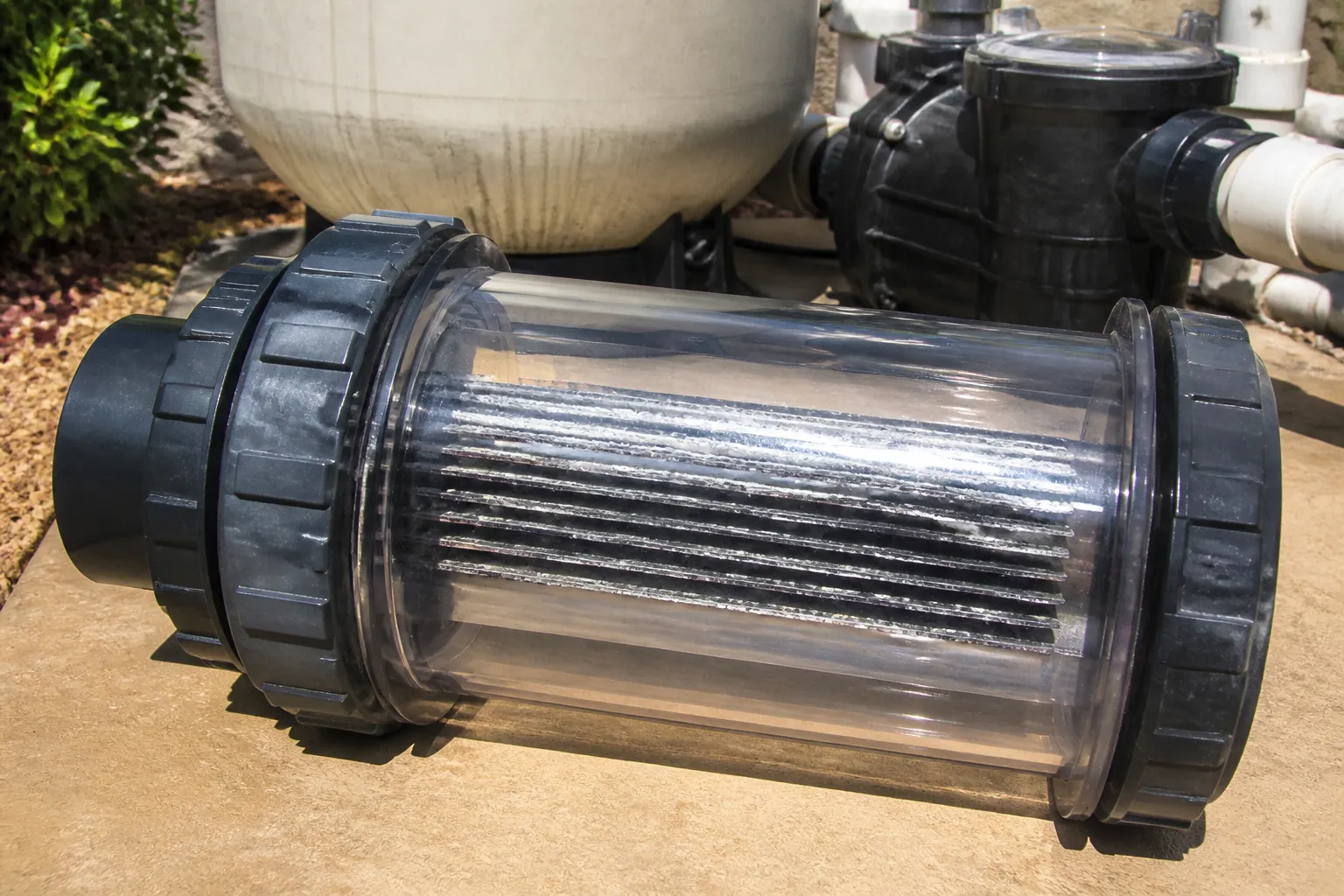
Tuesday morning, I was in the equipment room of a neighbour’s pool. The salt chlorinator’s display panel was flashing “Inspect Cell,” the water was turning cloudy despite readings that showed adequate salinity, and the owner standing next to me was convinced the entire generator had failed. Wrong diagnosis. The cell itself just needed a thorough cleaning.
What escapes most pool owners’ understanding is the remarkable work happening inside that salt chlorine generator buried beneath your equipment pad. Electrolysis is converting dissolved salt into hypochlorous acid — genuine chlorine — without chemicals being hauled in by trucks. But those titanium electrode plates, coated in their protective ruthenium-iridium layer? They’re under constant attack. Calcium carbonate and other hard-water minerals accumulate on those plates like sediment, blocking the cell’s ability to function. The result: water that looks tired, chlorine production that tanks despite salt levels staying stable, and a sinking feeling about that $700 investment.
The encouraging part: most of the time, this is correctable. Even better: you can prevent it altogether through deliberate salt cell care. I have spent years around pools as an owner, helping out at my own place and at the homes of neighbours and family, and I have read and tested a lot along the way. What I’ve noticed is that understanding your salt cell’s operational lifespan and recognizing when intervention is needed separates owners of reliably clear saltwater pools from those battling endless chemistry frustrations. Let me share what the data and my own experience have taught me.
Why This Problem Is Worse Than You Think
A salt chlorine generator cell accumulating scale doesn’t announce its decline with a bang. It deteriorates silently. By the moment you notice something’s amiss, you’ve already sacrificed several weeks of optimal chlorine production and your overall water chemistry has begun destabilizing.
The electrochemistry involved: your salt cell’s titanium plates operate via electrolysis. As electrical current travels through the cell, sodium chloride (the dissolved salt) transforms into sodium hypochlorite and hypochlorous acid — the active chlorine compounds that sanitize your water. But calcium carbonate scale functions as an electrical barrier. Picture attempting to recharge your phone through a thick fabric sheet. Electrical conductivity deteriorates. Chlorine output diminishes. And because the system’s salt measurement still registers within normal parameters, most pool owners look elsewhere for the culprit — they suspect the salt itself has lost potency, or they conclude the entire cell apparatus is defunct.
The fallout extends further than murky water:
- Water deteriorates rapidly: Insufficient chlorine creates favorable conditions for algal colonization. Once green algae establishes itself, you’re facing multi-day intensive chemical protocols, potential equipment deterioration, and in commercial or HOA situations, serious liability concerns. I’ve seen this happen on plenty of pools, including a few I’ve helped neighbours and relatives with, where routine maintenance got dropped and the pool ended up closed for a week while it was brought back.
- Equipment degradation accelerates: Faced with declining chlorine output, your natural instinct is to boost the generator’s amperage setting. Pushing the system harder means electrodes degrade quicker, and you compress what should be a 5-to-7-year cell lifespan into just 3 or 4 years. That $500 replacement becomes avoidable through foresight.
- Cash and hours disappear: Most pool stewards don’t understand what’s causing the deterioration, so they respond with supplementary liquid chlorine, intensified water testing, pH and alkalinity tweaks, and emergency service dispatch calls. I’ve documented situations where property owners invested $300-plus on technician visits to diagnose what a $30 cleaning solution could have resolved.
- Mineral deposits compound the problem: The longer calcium builds up on your electrodes, the more stubbornly it adheres. Fresh scale rinses away using mild acidic treatment in under 15 minutes. Thick, heavily-accumulated deposits from years of neglect demand aggressive intervention and carry a risk of harming the electrode surfaces themselves.
Maintaining your salt cell on a deliberate schedule isn’t a luxury — it’s the most important decision you’ll make regarding your saltwater pool’s operational longevity and your own peace of mind.
The Cleaner That Brought My “Dead” Cell Back to Life in 20 Minutes
When buildup accumulates on your cell — that powdery white calcium and mineral coating — chlorine stops flowing out even though your salt numbers stay ideal. That’s the moment most pool owners panic-order a $400 replacement. A properly formulated acidic cell cleaner dissolves that coating safely without compromising the electrode material, and honestly, it’s my first move before contemplating a cell replacement order.
What works
- Dissolves calcium deposits and mineral layers efficiently — I’ve observed cloudy water transform crystal-clear the same day after soaking the cell and reinserting it.
- Stretches cell operational viability by 1–3 additional seasons when you catch scaling in its early phases, keeping you from replacing cells annually on properties with challenging mineral-heavy water.
- Accessible for DIY implementation in approximately 30 minutes without voiding manufacturer coverage or requiring a paid technician visit.
What doesn’t
- Incapable of repairing electrodes that have suffered structural degradation or erosion — a genuinely compromised cell means cleaning only postpones replacement, not eliminates it.
- Demands you extract the cell securely, manipulate an acidic substance, and reintegrate the component with precision — not a hands-free alternative if equipment manipulation makes you uncomfortable.
I almost bought a full replacement cell online before I remembered to check the manufacturer’s cleaning protocol first—and I’m glad I did, because a $30 bottle of salt cell cleaning solution like BioGuard Mineral Springs Cell Cleaner saved me hundreds that week.
Salt Chlorine Generator Life Expectancy: Common Questions
What is the life expectancy of a salt chlorine generator cell?
For a residential pool cell, plan on three to seven years. The spread is wide because cell life is not really measured in calendar years — it is measured in operating hours. Most manufacturers rate a cell somewhere in the range of 10,000 hours of active generation, so the same cell can last three years on a pool that runs long pump cycles at a high output percentage in a warm climate, or seven on a pool that runs a short season at a modest output setting.
Three things shorten it faster than anything else: running the output percentage far higher than the pool actually needs, letting calcium scale build up between cleanings, and chronically low pH, which is aggressive to the plate coating. A spa cell is a different calculation entirely and runs on a much shorter clock — that is covered separately in the hot tub salt cell guide.
How can I tell how much life my cell has left?
Work through these in order rather than guessing:
- Check the controller’s hour counter. Many systems track cumulative cell hours in a diagnostic menu. Compare that against the manufacturer’s rated hours — this is the closest thing to a direct readout of remaining life, and most owners never realize it is there.
- Track the output percentage you need over time. This is the most reliable practical indicator. If holding the same free chlorine level used to take 50% output and now takes 80%, the cell has measurably lost capacity even if it has not thrown an error yet. Note your setting each season and the trend becomes obvious.
- Inspect the plates after a proper cleaning. Healthy titanium plates are a uniform silver-grey. Dark patches, flaking, or visible pitting that remains after the scale is fully dissolved is permanent coating loss, not dirt.
- Watch the cleaning interval. A cell that needs descaling every few weeks instead of every few months has pitted enough to trap deposits, and it is running on borrowed time regardless of what the display reports.
- Rule out the cheap causes first. Low salt, low water temperature, and high stabilizer all suppress chlorine output and are routinely mistaken for a dying cell. Confirm those are in range before you spend anything.
About This Article
Written by Nadia Caldwell. Backyard pool owner and water chemistry nerd. After years of chasing down cloudy water and algae blooms on my own pool and my neighbors', I now write about pool maintenance, water treatment, and everything chlorine-related for everyday pool owners. More about this site.
Scope and limits. Nadia is a pool owner who reads chemistry, not a certified pool professional. Follow label directions on every chemical, never mix them, and use a certified pool operator for equipment and sanitizer system work.
Verify this against a primary source
Specifics change, and your situation may differ from the one described here. These are the authorities worth checking directly:
- World Health Organization — guidelines for safe recreational water environments
- Pool & Hot Tub Alliance — water chemistry and pool operation standards