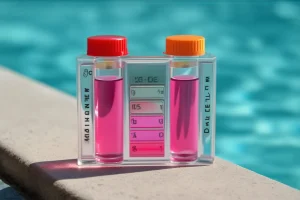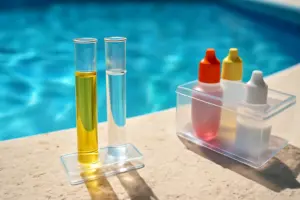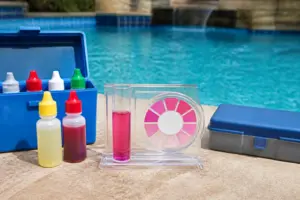
Suppose you’re dosing shock at 20 ppm and your CYA reads 110 ppm. That’s the moment people start screaming “chlorine lock” online. They’ve dumped chemicals, nothing visibly improves, and panic sets in. The chlorine won’t budge on the test kit. They’ve absorbed the cyanuric acid chlorine lock myth wholesale, treated it as settled fact, and now they’re convinced the pool is fundamentally broken. The reality is messier—and more fixable—than internet folklore suggests. What you’re actually seeing is a chemistry problem with a straightforward solution, not a curse that requires draining your entire pool.
My work across Arizona, Nevada, and New Mexico managing everything from resort complexes to HOA facilities to municipal installations has kept me in the trenches with water chemistry for more than a decade. The Southwest’s combination of brutal heat, relentless sun exposure, and high guest turnover creates conditions where stabilizer chemistry either works perfectly or breaks your budget trying. Cyanuric acid surfaces in nearly every project I touch. I’ve witnessed property managers needlessly drain thousands of gallons because they got the CYA story wrong. Conversely, I’ve found pools running at 200+ ppm CYA where chlorine had become practically inert. Both scenarios stem from the same root cause: misunderstanding what CYA is, what it isn’t, and what the numbers actually mean.
This piece walks through the real chemistry of cyanuric acid and free chlorine interaction, separates fact from the “chlorine lock” narrative that circulates endlessly, and supplies the actual numbers you need to run your pool properly. No shortcuts. No vague generalizations. Just the concrete takeaways drawn from years of hands-on field testing and troubleshooting.
What Cyanuric Acid Actually Does in Your Pool
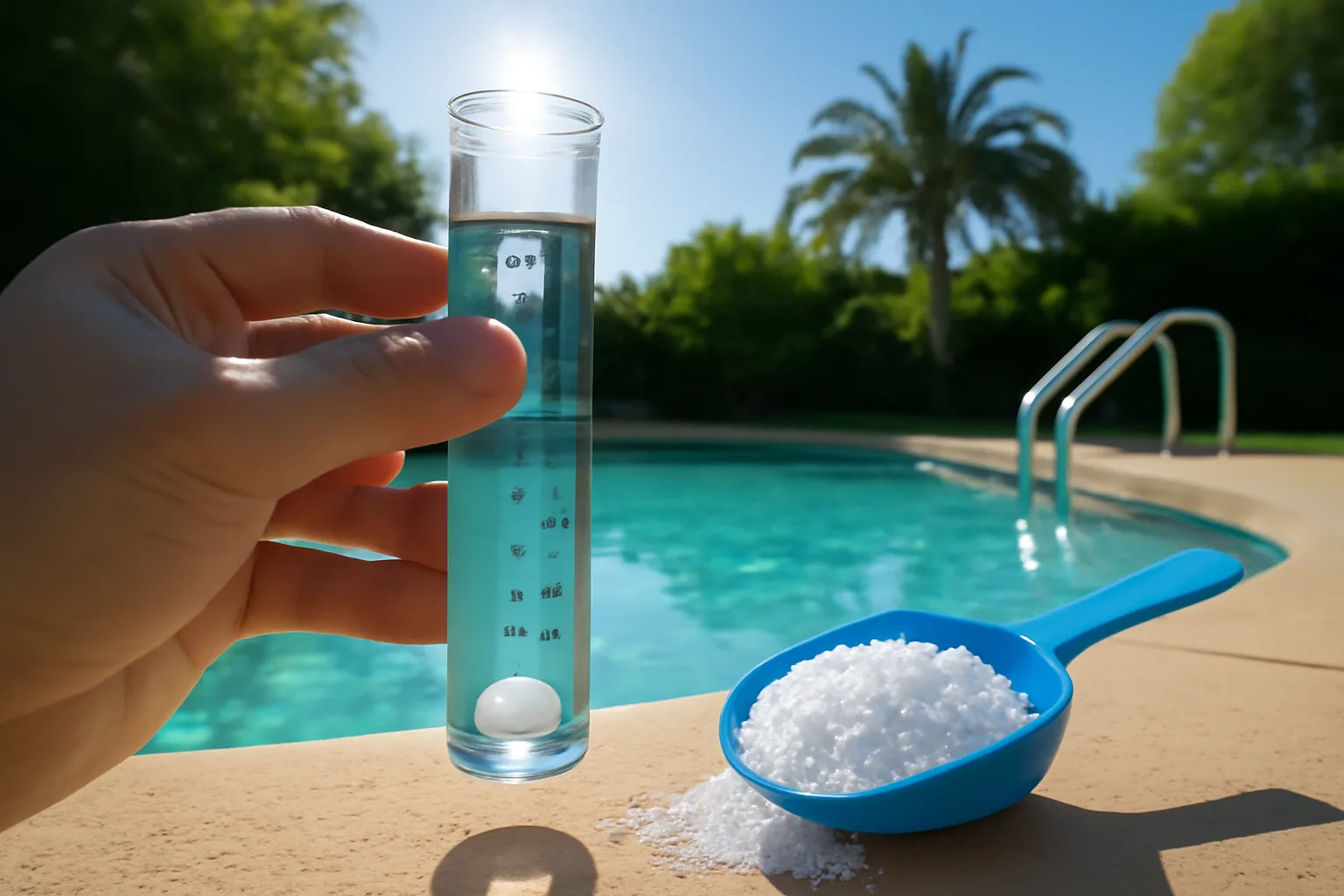
Cyanuric acid—CYA, also sold as pool conditioner or stabilizer—is a UV shield. It bonds reversibly with free chlorine, shielding the chlorine molecule from solar radiation. Without it, direct sunlight obliterates roughly 90% of your free chlorine in a span of two hours. This isn’t hyperbole. In the desert Southwest, where I spend most of my time, an unprotected pool hemorrhages chlorine on a July afternoon faster than any practical dosing schedule can replenish it.
The chemistry breaks down like this: CYA functions as a temporary storage tank for chlorine molecules. UV radiation can’t degrade the sheltered chlorine in quite the same way it destroys free hypochlorous acid floating unbound in your water. Once chlorine is needed for disinfection, the chemical bond releases it back into circulation. The system operates in real time and perpetually. Visualize CYA less as a trap and more as a time-release capsule.
The complication is that this protective mechanism simultaneously weakens chlorine’s raw disinfecting capability. The actual disinfectant—hypochlorous acid, or HOCl—depends on being free and unbound. When CYA is dissolved in your water, a chunk of your free chlorine exists as complexed cyanurate molecules—meaning it’s chemically unavailable to kill pathogens instantly. This is the fundamental give-and-take underlying every conversation about CYA.
The Cyanuric Acid Chlorine Lock Myth — What People Get Wrong
The phrase “chlorine lock” travels across pool websites and forums as though it refers to some universally understood malfunction with a fixed trigger point. It doesn’t exist as such a thing. No standards body has published a definition stipulating that CYA at concentration X causes chlorine to become entirely inactive. Yet forum threads routinely claim anything above 100 ppm CYA results in total chlorine lock. That’s an oversimplification with consequences.
Here’s what’s genuinely accurate—and this distinction matters profoundly: elevated CYA compresses the fraction of free chlorine present as reactive HOCl. Holding pH steady at 7.5 with 30 ppm CYA produces roughly 3% active HOCl in your free chlorine measurement. That same pH at 100 ppm CYA yields around 1% active HOCl. Your chlorine isn’t imprisoned. It’s simply weaker per ppm you add. You adapt by holding your free chlorine target higher to compensate.
I discovered this through painful trial-and-error early in my career. Running a 150,000-gallon resort facility in Scottsdale, I watched CYA accumulate to 120 ppm over an entire season of feeding trichlor tabs into the feeder. Guests reported algae blooms starting to show. I kept piling in more chlorine with minimal improvement. I was convinced the pool was “locked.” The actual problem: I hadn’t raised my free chlorine target to match the higher CYA concentration—and I hadn’t partially drained to bring CYA back into workable range. That partial drain ultimately ran about $400 in water loss and chemical rebalancing expenses. A $15 CYA test kit would have surfaced the issue six weeks sooner and saved that bill.
The Real Issue: CYA-to-Chlorine Ratio
Forget “chlorine lock.” The correct model centers on CYA-to-chlorine ratio. Work by researcher Richard Falk and principles embedded in the Langelier Saturation Index point toward a floor: your free chlorine should equal no less than 7.5% of your CYA concentration. Case in point: if CYA sits at 40 ppm, your minimum free chlorine target becomes 3 ppm. At 80 ppm CYA, you’re aiming for at least 6 ppm free chlorine. At 100 ppm, that floor rises to 7.5 ppm. The relationship is strictly proportional.
The CDC’s Model Aquatic Health Code (MAHC) designates a range of 10–90 ppm CYA for outdoor pools relying on chlorine as primary sanitizer. Throughout the Southwest, numerous state health department regulations cap CYA at 100 ppm when it comes to commercial aquatic facilities. The Pool & Hot Tub Alliance (PHTA) suggests 30–50 ppm as the sweet spot for residential installations. These aren’t picked at random. They reflect evidence accumulated across decades of operational data and sanitization research.
How CYA Accumulates — and When It Becomes a Real Problem
Cyanuric acid exits your pool only through dilution or drainage—it doesn’t evaporate into the air, and it isn’t consumed during the sanitization process. Each dose of trichlor tablets or dichlor shock introduces additional CYA. Trichlor consists of roughly 57% CYA by mass. Dichlor carries approximately 33% CYA by mass as ballast.
In practice, residential or commercial pools fed exclusively on trichlor pucks throughout a season, with no regular CYA testing, routinely hit 100+ ppm by the hottest weeks. I’ve tested August pools sitting at 180 ppm CYA. At those concentrations, you face a genuine problem—not because chlorine becomes “locked,” but because maintaining adequate free chlorine (13+ ppm) for disinfection becomes uncomfortable for swimmers and practically difficult to sustain consistently.
That’s where real difficulties start. Once CYA climbs past 100 ppm, keeping chlorine levels where they need to be becomes operationally burdensome. Most Southwest state regulations treat 100 ppm as the regulatory boundary for commercial pools. From my perspective on residential pools, I suggest planning a partial drain once CYA exceeds 80 ppm. A partial drain—typically removing and replacing 25–50% of the water—brings CYA concentration back into workable bounds. Depending on local water pricing, this typically runs $30–$150 for residential installations.
Switching from Trichlor to Cal-Hypo or Liquid Chlorine
The most reliable prevention strategy in my toolkit involves swapping your main disinfectant. Calcium hypochlorite granules and liquid chlorine (sodium hypochlorite solution) introduce zero CYA. If years of trichlor reliance have left you with elevated CYA, migrating to liquid chlorine and incorporating CYA as a separate, targeted amendment—added once and then left alone—grants you finite control. You settle on a target of 40–50 ppm CYA, dose granular CYA a single time to reach it, and then carry the season with liquid chlorine only. This is the framework I’ve implemented across every HOA pool in my portfolio.
The Test Strips That Finally Let Me Stop Guessing About Cyanuric Acid Levels
What remains unmeasured cannot be managed intelligently—and cyanuric acid exists invisibly in your water. Without dependable data, distinguishing genuine chlorine lock from reactive panic-buying is impossible.
What works
- Delivers a concrete cyanuric acid result in moments rather than leaving you to infer from murky water or disappointing chlorine numbers
- Covers all seven major water parameters simultaneously (free and total chlorine, pH, total alkalinity, calcium hardness, CYA, and acid demand), preventing tunnel vision on one variable while others shift
- 150 strips per container supplies enough capacity for frequent testing each week without hesitation, which becomes essential when chasing down a suspected stabilizer imbalance
What doesn’t
- Test strips sacrifice the granularity of calibrated liquid reagent kits for speed—they’re engineered to reveal patterns and shifts, not to deliver laboratory-grade precision on every individual measurement
- The color block for CYA can prove tricky to interpret beside the comparison card, particularly for people with color perception differences or when ambient lighting is poor
I almost didn’t buy test strips because I thought they were too basic for “real” pool chemistry — until I realized I’d been adding shock blindly for weeks without actually knowing my cyanuric acid level. Grab EASYTEST 7-Way Pool Test Strips (150 strips) and stop guessing.
This post contains affiliate links. As an Amazon Associate, I earn from qualifying purchases at no extra cost to you.
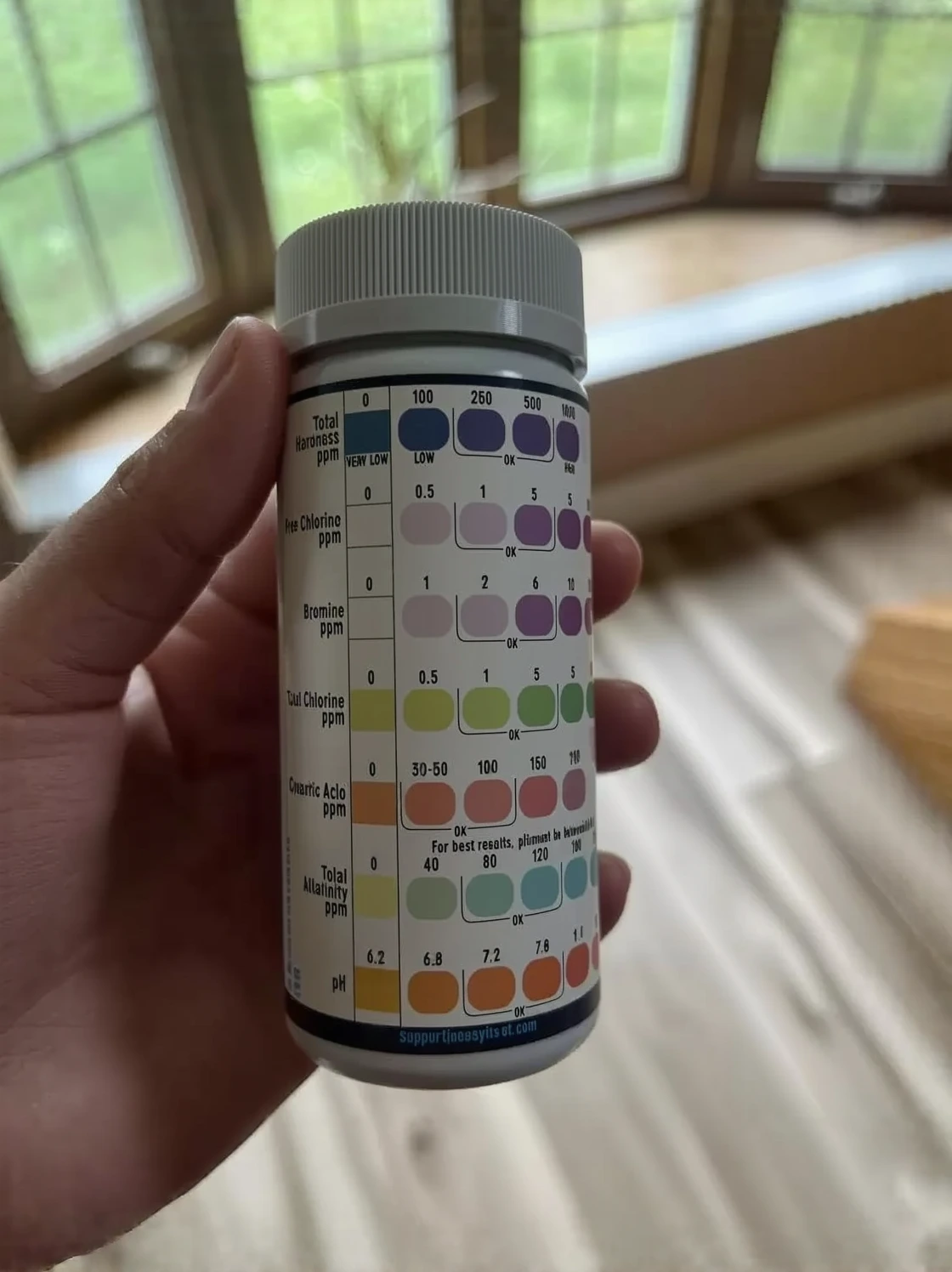
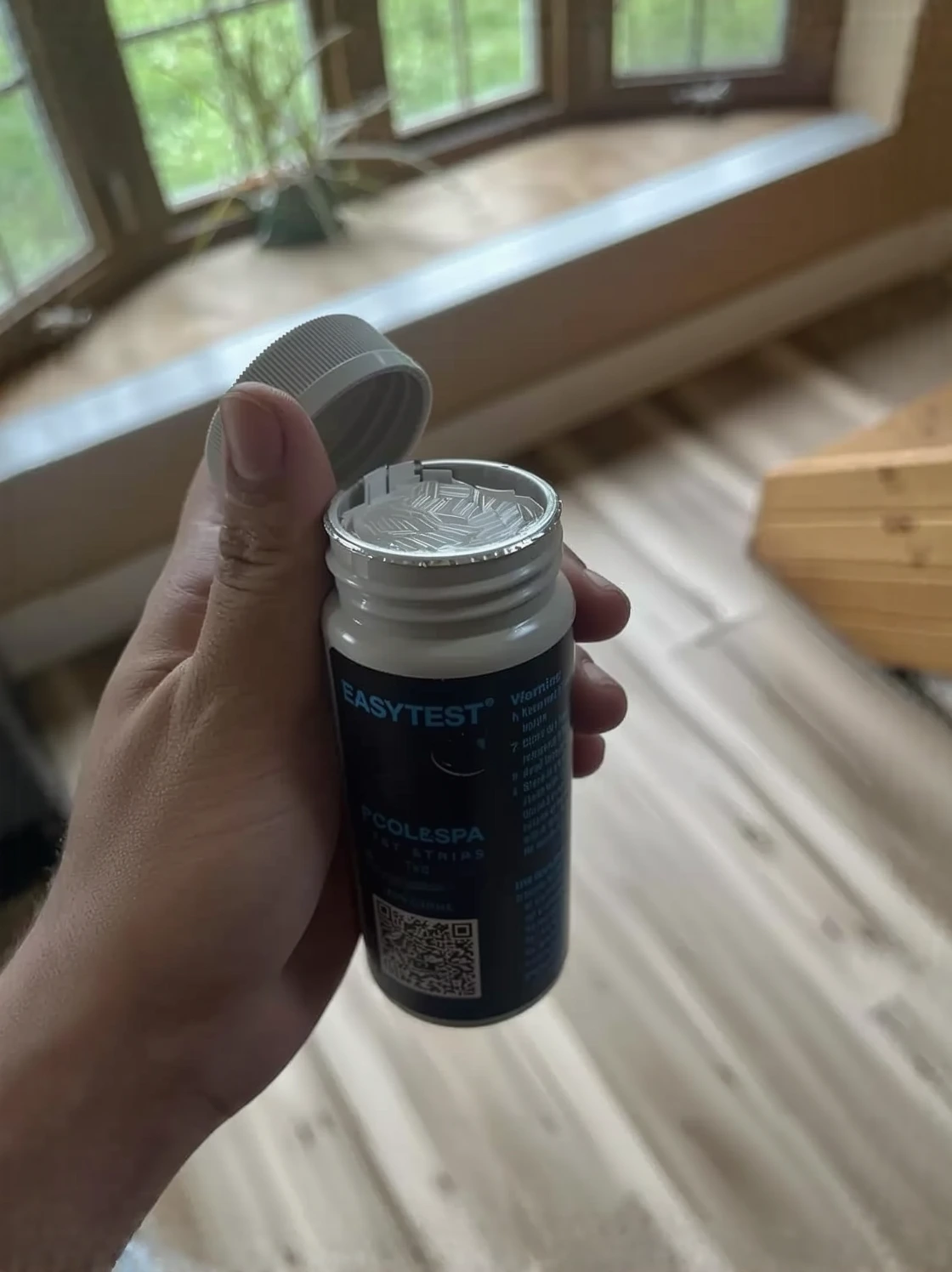
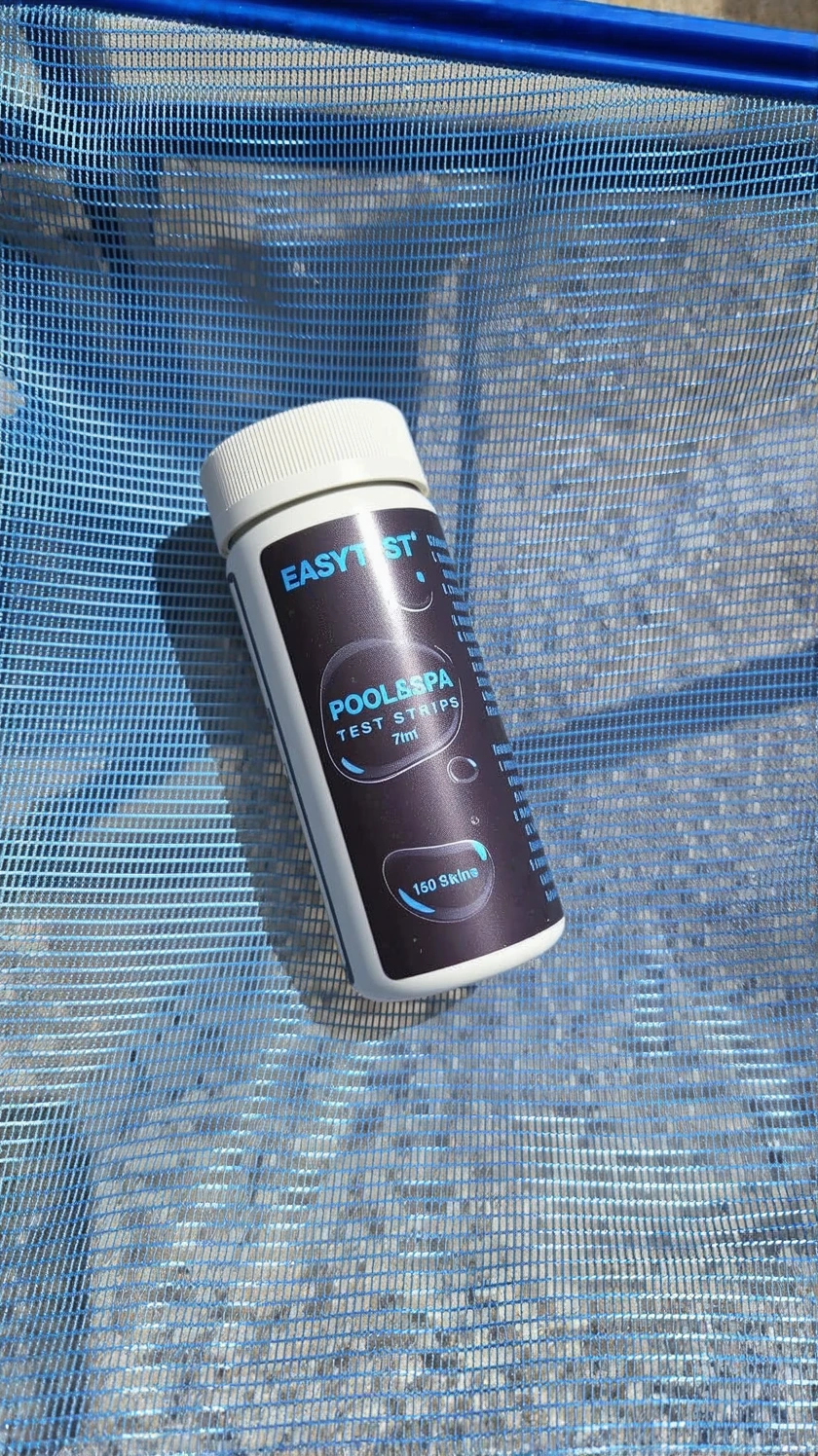
EASYTEST 7-Way Pool Test Strips (150 strips)
I test weekly now instead of guessing whether cloudy water means chlorine lock or something else entirely.
Check Price on Amazon →