I get asked the same question at least once a week: “Should I install a salt chlorine generator or just use an automatic chlorine feeder?” And almost every time, the pool owner asking me is surprised to learn that these are two completely different pieces of equipment doing chlorination in opposite ways.
In my fifteen years managing resort and HOA pools across the Southwest, I’ve run both systems side-by-side. I’ve replaced dead salt cells at $600 a pop. I’ve also pulled pools out of “chlorine lock” caused by runaway CYA from feeder tablets. The honest answer? Both work. The real question is: which one solves your problem without creating a new one?
Here’s what I wish someone had explained to me before I spent thousands on my first salt system upgrade: the marketing term “chlorine generator” gets thrown at two unrelated devices. One manufactures chlorine on-site from dissolved salt via electrolysis. The other automatically feeds stabilized tablets into your return line. The chemistry is opposite. The upfront cost is opposite. The maintenance is opposite. And yet, most pool stores talk about them like they’re interchangeable—they’re absolutely not.
Let me break down the real difference between salt chlorine vs dry chlorine generator, and help you figure out which one actually makes sense for your pool.
Why This Problem Is Worse Than You Think
The confusion between a salt chlorine generator and a dry chlorine feeder costs pool owners real money—sometimes thousands in the wrong direction.
Here’s why this matters: when you’re building a new pool or replacing equipment after a failure, you’re making a decision under time pressure. The pool store’s sales associate explains (or doesn’t explain) that you need “automatic chlorination,” quotes you a salt system at $1,200–1,800 installed, and you nod along because “automatic” sounds easier. Three years later, you’ve replaced a $500 salt cell, spent $200–400 a season on tablets anyway because you’re also running a floater as backup, and your CYA has somehow drifted to 120 ppm because nobody told you how the math works.
Or the opposite: you install a $150 inline feeder because it’s cheap and easy, feel proud of yourself for a season, then get blindsided when your CYA creeps past 80 ppm by year two. Now you’re looking at a $1,500 partial drain and refill to reset your stabilizer levels, and you’re wondering if you should have just bitten the bullet on the salt system.
The root cause is that nobody—not the stores, not the pool service companies, sometimes not even the manufacturers—actually explains what these two systems do differently at a chemical level. They just say “salt” or “tablets” like the choice is obvious.
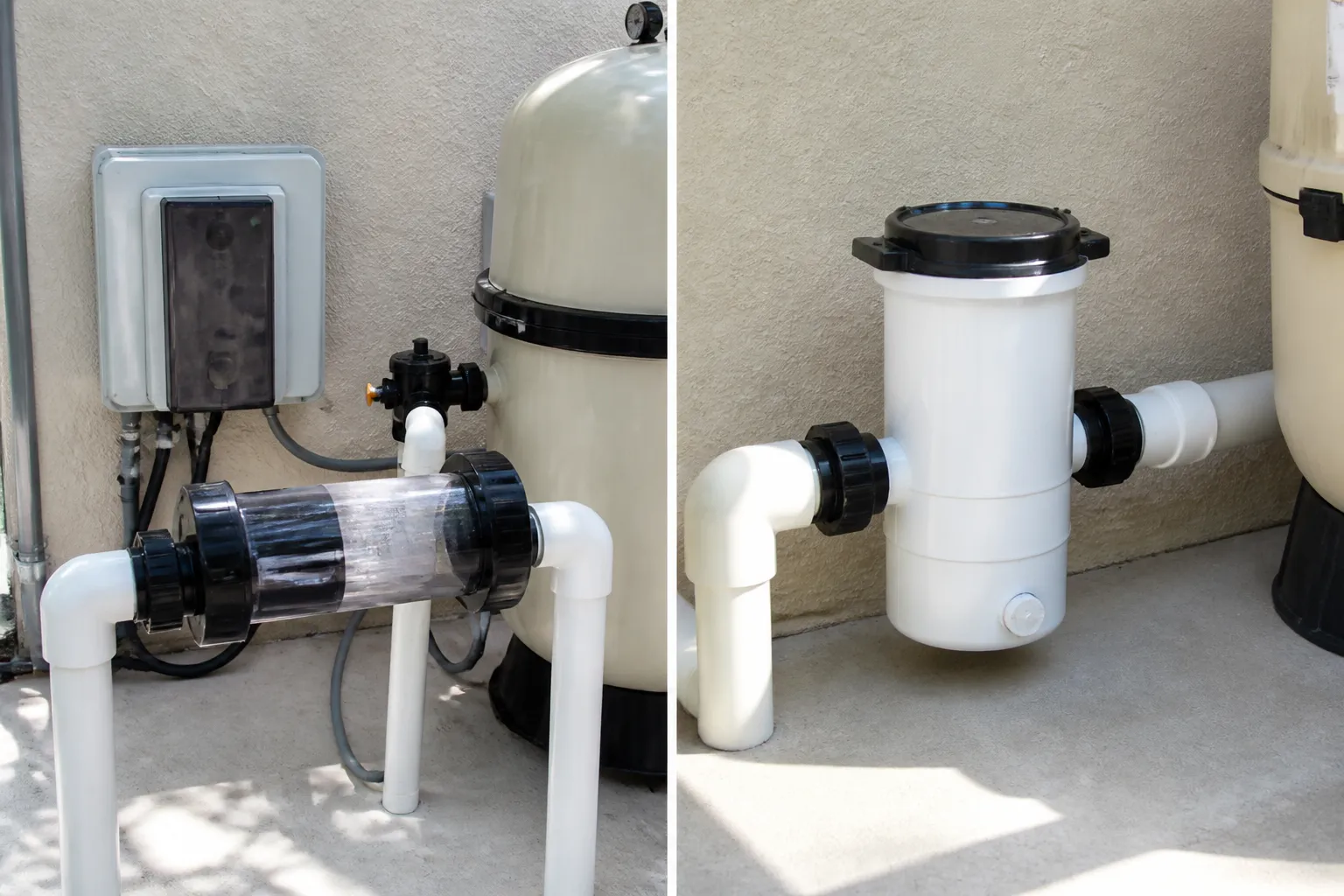
The reality: A salt chlorine generator creates chlorine from salt (sodium chloride) dissolved in your water via electrolysis. The cell’s titanium plates, running on low-voltage DC current, split the salt into chlorine gas, which immediately dissolves into hypochlorous acid—the active sanitizer. The system works 24/7 when your pump is running, metering chlorine continuously.
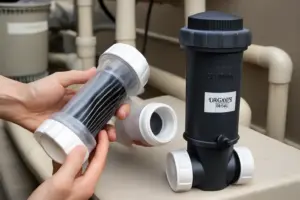
A dry chlorine feeder does something completely different: it holds stabilized trichlor tablets (typically 3-inch tabs, 90% available chlorine) in a sealed canister. A fraction of your pool return water gets diverted through the canister via a valve you adjust with a dial. The water slowly erodes the tablets, dosing chlorinated water back into your pool at a rate you control. No electrolysis, no electricity beyond your pump, no salt—just tablet dissolution.
Both put chlorine in your water. Both can keep a pool safe and clear. But the chemistry they impose on your pool is fundamentally different, and that difference compounds over time.
What to Look For in an Inline Automatic Chlorine Feeder
If you’re considering a dry chlorine feeder as your primary chlorination method—or as a backup system for a salt pool—here are the features that actually matter, and where the Hayward CL200EF in-line automatic chlorine feeder stands out from cheaper alternatives.
Capacity and Build Quality
The Hayward CL200EF holds up to 9 pounds of trichlor tablets—roughly 12–15 standard 3-inch tabs depending on how tightly they’re stacked. That translates to 2–4 weeks of run time for a typical 15,000-gallon residential pool in the Southwest, maybe slightly longer in cooler climates or with lower bather load.
The body is molded polypropylene, UV-resistant, and designed to handle the mild chemical environment created by trichlor erosion. Cheaper feeders sometimes use lower-grade plastic or metal that starts corroding after a season or two. The Hayward’s construction means it’ll stay functional for 5–7 years if you’re not abusing it.
Adjustable Flow Control
The heart of any feeder is the dial valve that meters water through the tablet chamber. The CL200EF has a smoothly adjustable valve (not a clunky multi-position selector like some budget models) that lets you fine-tune output between roughly 0.5 and 3 ppm free chlorine increase per pass through. You can dial in exactly the dose your pool needs without the on-off-on cycling that makes cheaper feeders unpredictable.
This matters more than you’d think. A poorly tuned feeder either starves your pool and lets algae take hold, or overshoots and creates so much combined chlorine (chloramines) that visitors complain about the “chlorine smell” even though your free chlorine reads fine on a test kit.
Bypass Valve and Check Ball
The CL200EF includes a bypass valve that prevents excessive back-pressure if the tablet chamber gets clogged (usually from calcium scale buildup or a stuck tablet). Without this, pressure can creep up and cause leaks or rupture the seal. It’s a small detail, but it’s the difference between a feeder that lasts five seasons and one that springs a leak in year two.
The internal check ball prevents siphoning—water flowing backward out of your pool and through the canister when the pump shuts off, which wastes tablets and creates uneven chlorine distribution. Again, budget models skip this.
Easy Access and Sealed Design
The CL200EF has a hinged top access cover with a replaceable o-ring seal. You can refill tablets in under two minutes without tools. A bad seal—or a design that forces you to wrestle with the canister every time you refill—will drive you crazy after the third season. This feeder’s design keeps maintenance frictionless.
One honest limitation: the Hayward CL200EF is sized for pools up to roughly 20,000 gallons. If you have a 30,000+ gallon pool, you may need to run two feeders in parallel, or accept that refills will be every 10 days instead of every 2–3 weeks. It’s not a flaw in the product—it’s the reality of how feeders scale.
How to Use It Like a Pro
Installation is straightforward enough that most handy pool owners can do it themselves, though a licensed pool tech can usually finish it in under an hour. The feeder needs to be mounted on the return line after the filter but before the pool returns. This ensures filtered water gets dosed with chlorine, not raw trichlor floating into your pool unpredictable.
The plumbing is simple: you tee into the return line with 1.5-inch PVC, use unions on either side of the feeder (so you can service it without draining the whole system), and dial in your flow rate based on your pool’s needs and current free chlorine levels.
Setting the Dial: The Adjustment Process
Here’s the pro method I use on every new feeder installation:
- Load the feeder with tablets and set the dial to the 50% position (middle of the range).
- Let it run for 48 hours while the pump operates normally (accounting for typical run time).
- Test free chlorine. If it’s climbing steadily but staying under your target (1.5–3 ppm for residential), you’re in the ballpark. If it’s stalled or dropping, increase the dial. If it’s climbing faster than you want, decrease it.
- Make small adjustments (quarter-turns) and wait another 24 hours between changes. Resist the urge to spin the dial wildly—chlorine’s effect is lagged; what you change today won’t fully show until tomorrow.
During swim season, test free chlorine at least twice weekly (three times if you have heavy bather load). If free chlorine starts creeping above 5 ppm, dial back. Below 1 ppm consistently? Dial up. This feedback loop takes maybe five minutes a week once you’re dialed in.
Tablet Refilling and O-Ring Maintenance
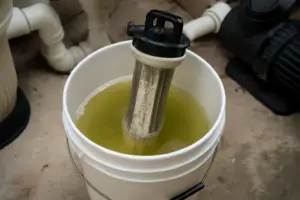
Every 2–4 weeks during swim season, you’ll refill the tablet stack. Loosen the o-ring-sealed lid, slide out the remaining tablets (some will be mostly gone, some just smaller nubs), and stack fresh 3-inch trichlor tabs in their place. Make sure the lid’s o-ring stays wet and clean—a dry o-ring shrinks and cracks, and a dirty one (covered in tablet residue or calcium) won’t seal properly. I rinse mine under the garden hose and inspect it for splits every refill.
If your feeder output suddenly drops without explanation, the first thing to check is that o-ring. A bad seal lets bypass water flow around the tablets without getting chlorinated, and you’ll swear the feeder is broken when really it’s just not sealing anymore.
Managing CYA: The Thing Nobody Mentions
This is critical: trichlor tablets are stabilized with cyanuric acid (CYA). Every tablet you feed adds roughly 0.5–1 ppm CYA to your pool water. CYA doesn’t evaporate, doesn’t break down, and doesn’t leave your pool naturally—it only leaves via dilution or draining.
For a feeder-only pool, this means your CYA will climb steadily. Start measuring it every season. If it hits 60–80 ppm, you’re still fine. But once it creeps past 80–100 ppm, your chlorine’s killing power gets blunted. A free chlorine of 2 ppm with 100 ppm CYA is actually acting more like 0.5 ppm chlorine in an unchlorinated pool—this is “chlorine lock.”
The fix: every 2–3 years, plan on draining roughly 25–50% of your pool and refilling it with fresh water. This dilutes the CYA back to a reasonable range (20–40 ppm is ideal). It’s not glamorous, but it’s straightforward. A lot of feeder-pool owners do this at season’s end anyway when they’re already thinking about water turnover.
Pairing It With the Rest of Your Routine
An inline feeder isn’t a “set it and forget it” system. But neither is a salt generator—they just require different maintenance calendars.
With a feeder, your weekly routine stays simple: test free chlorine (and pH, alkalinity, the usual suspects) twice a week during heavy use, adjust the dial if needed, and visually inspect the o-ring seal when you refill tablets. Every season, test CYA and note the trend. Keep a simple log—I use a spreadsheet—so you can see whether CYA is climbing faster or slower than expected (faster usually means more bather load; slower usually means better dilution from rain or splash-out).
The feeder pairs beautifully with brush and vac maintenance (no different than any pool), filter cleaning on schedule (every 4–6 weeks depending on load), and acid additions to manage pH—yes, feeder pools still need acid dosing, especially in the Southwest where our fill water is naturally alkaline. The feeder doesn’t handle pH; it only handles chlorine.
Seasonal consideration: In winter, when water temperature drops and bather load falls off, you can dial the feeder down or even close it completely and rely on a shock dose every 2–3 weeks. This saves tablets and slows CYA accumulation. Come spring, ramp it back up over a few days, retesting as you go. It’s the opposite of a salt system, where the cell keeps running and outputting chlorine 24/7 regardless of whether anyone’s in the water.
One more thing: if you ever need to shock the pool (which you should do monthly or after heavy use), you can still use liquid or powder shock while the feeder is running. The feeder’s job is to maintain baseline chlorine; shocks are a separate intervention. Just don’t double-dose chlorine from multiple sources without testing—it’s hard to overdose accidentally, but it’s possible.
The Bottom Line
The choice between salt chlorine vs dry chlorine generator isn’t actually about which is objectively “better.” It’s about which aligns with your budget, pool usage, and tolerance for different kinds of maintenance.
Choose an inline automatic chlorine feederHayward CL200EF—if you’re building a new pool on a tight budget, you have a smaller or seasonal pool, you’re comfortable managing CYA with periodic dilution, or you want a simple backup system for a salt pool. The upfront cost is $60–350 depending on whether you DIY, and it’ll deliver years of reliable chlorination for $150–350 per season in tablets.
Choose a salt chlorine generator if you’re committed to the long game, value ultra-low-maintenance day-to-day operation, swim frequently, and are willing to budget for a $500–800 cell replacement every 3–7 years. You’ll spend more upfront, but your chemical balancing (aside from pH management) becomes more passive, and the water feels softer.
I’ve managed properties using both systems. I’ve had great experiences with both. I’ve also had both fail or frustrate me when they weren’t matched to the property’s actual needs. The real mistake is letting someone else make this decision for you without understanding the tradeoffs. Now that you do, you’ll make the choice that actually works for your pool.
Affiliate Disclosure: This post contains affiliate links. As an Amazon Associate, I earn from qualifying purchases. If you buy something through my links, I may earn a small commission at no extra cost to you. I only recommend products I’ve actually used on the pools I manage.