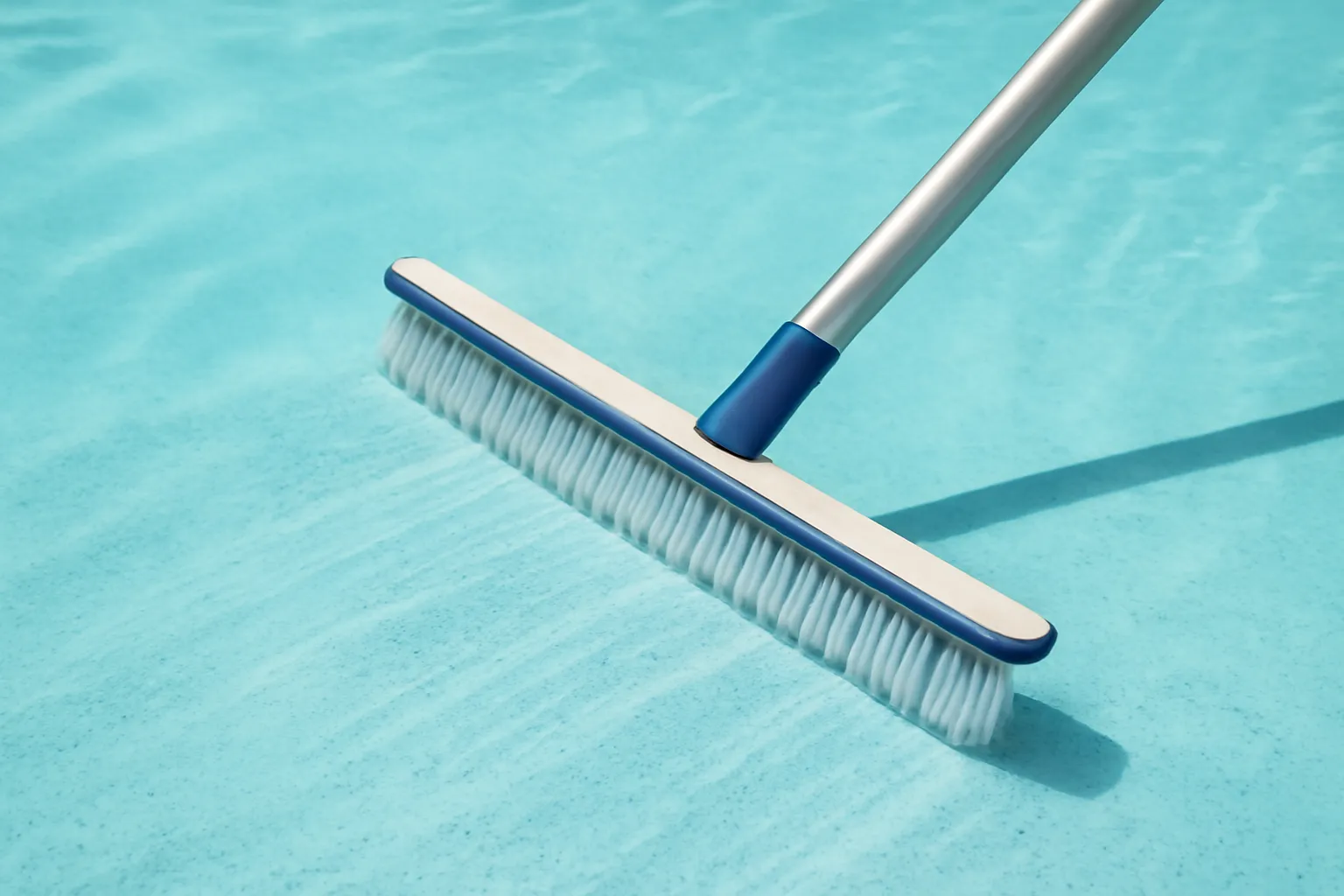
What’s actually stopping your pool from clearing up when algae blooms hit? Odds are strong it’s not your chlorine dose — it’s the brush you’re holding. Picture this instead: it’s dawn on a Tuesday at a big 75,000-gallon pool outside Phoenix, and the shallow end’s concrete steps have developed a yellowish-green film thick enough to notice from across the deck. I grab a standard soft-bristle nylon brush attached to my pole and spend the next twenty minutes scrubbing. My arms are screaming. The algae? It’s basically redistributed itself. The steps look virtually unchanged. If you’ve wrestled with stubborn algae coating concrete or plaster surfaces using nothing but a flexible nylon brush, that frustration is familiar territory. It feels like mopping with a sponge instead of bristles. The bristles collapse under pressure instead of penetrating, the algae persists unmoved, and you’re expending effort on a losing proposition. From my own pool and the ones I’ve helped neighbours and family with over the years, I’ve learned that the brush itself is perhaps the most overlooked and misunderstood piece of maintenance equipment in the industry — and most backyard owners I talk to have the wrong one in their hands. If you’re hunting for an effective pool brush designed specifically for concrete and plaster surfaces, I’ll cut straight through the noise and show you what actually delivers results.
Why Brushing the Wrong Way Is Worse Than Not Brushing at All
Here’s what most maintenance articles conveniently omit: using an ineffective brush doesn’t merely squander your effort — it fundamentally undermines your chemistry balance and drains your budget. When you smear algae across your pool surface instead of mechanically dislodging it with a proper tool, you’re scattering millions of algal cells and spores across concrete or plaster. Those cells resettle into the microscopic pitting and crevices of your pool’s surface and colonize anew, frequently with accelerated growth. You’ve essentially replanted an algae crop into your pool.
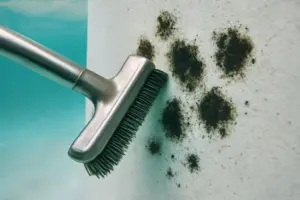
At the microscopic scale, concrete and gunite finishes are inherently porous and textured. That same surface roughness that provides slip resistance to your feet is precisely where algae organisms — whether green, mustard-colored, or the black variety — establish their cellular anchors. These organisms burrow into surface fissures and microscopic indentations. A soft nylon bristle lacks the rigidity to reach into these microscopic anchors. It glides over the top. Stainless steel bristles operate differently: they penetrate into those fissures and physically disrupt the algae’s structural attachment to the substrate — the mechanical action your chlorine residual absolutely requires before it can neutralize the threat. One important exception: on plaster that is still curing, stainless bristles will cut the soft surface and leave permanent scratch lines, so a new pool needs a soft nylon brush for its first month instead.
Now factor in the financial impact on your sanitizer: chlorine oxidizes algae cells suspended freely in your water quite readily, but algae anchored to a textured surface remains largely inaccessible. The protective mucopolysaccharide film that algae secretes acts as a chemical barrier. Commercial pool operators recognize that a genuine algae outbreak demands shock treatments in the 10–30 ppm range — frequently requiring repeated applications over multiple days to fully resolve. Neglect proper brushing technique, and you’re watching dollars of purchased chlorine disappear into the pool without proportional chemical effectiveness. Using current cal-hypo pricing, a single bloom cycle can consume $40–$80 in additional chemicals, before factoring in labor time spent waiting for turbidity to drop.
Your circulation system faces a secondary burden. Algae that remains mechanically attached to pool surfaces never becomes suspended in the water stream where filtration media can intercept and retain it. The organism persists on your surfaces and multiplies unchecked. Proper brushing — executed correctly with appropriate equipment — propels organic debris into the water column where your filter’s media can capture and remove it. I’ve witnessed pools transition from cloudy to crystal in a single day following methodical brushing paired with shock treatment, whereas chemistry-only approaches had prolonged turbidity for nearly a week.
What to Look for in the Best Pool Brush for Concrete Plaster Pools
Surface compatibility determines whether a brush investment yields results or creates problems, and many pool owners make the incorrect choice before they ever enter the water. Here’s how the primary categories break down:
Pure Nylon Bristle Brushes
Compatible across vinyl linings, fiberglass shells, ceramic tile, and plaster finishes without damage risk — but mechanically insufficient when confronting established biofilm on textured concrete or plaster substrates. Soft bristle construction yields to resistance rather than forcing through it. These function acceptably for periodic light cleaning on an already-clean pool surface, but the moment algae colonizes rough concrete or plaster, nylon-only construction simply cannot generate sufficient mechanical force to break the attachment.
Pure Stainless Steel Bristle Brushes
Forceful enough to successfully tackle concrete, plaster, and gunite finishes. This same mechanical aggression will groove and permanently damage vinyl pool linings and fiberglass surfaces, restricting these brushes exclusively to hard-substrate installations. They produce tangible results, yet demand heightened operator attention — particularly around transition zones between materials and near fittings and drains — and represent overkill for casual maintenance cycles.
The Brush Model That Actually Removes Algae Rather Than Smearing It
That soft nylon brush occupying my equipment rack? It was counterproductive — redistributing cells across the deck surface rather than extracting them. My real bottleneck wasn’t my stroke mechanics; I’d simply picked up the incorrect implement for the job.
Strengths
- Stainless steel bristles bore through resistant algae buildup and mineral deposits — they cut rather than deflect — and I watched those Phoenix concrete steps go from coated to visibly cleaner in under four minutes flat.
- A reinforced aluminum frame provides genuine mechanical advantage and directional control, so your shoulder and back muscles aren’t shouldering the entire burden of forcing the brush across the pool bottom and walls.
- The hybrid bristle configuration adapts across plaster pools and concrete installations without requiring equipment swaps when transitioning between different substrate regions.
Limitations
- Greater overall mass compared to lightweight nylon alternatives translates to accelerated muscle fatigue during extended single-session pool cleaning without adequate recovery intervals.
- At 18 inches across, maneuvering into recessed corners and tight spaces surrounding ladder equipment presents coordination challenges that narrower brush heads would eliminate.
I almost talked myself out of upgrading because the price felt high compared to my hardware-store brush, but after that first morning watching algae actually come off instead of spread around, I realized I’d been penny-wise and pound-foolish for months. POOLMAVEN 18-Inch Gunite Inground Pool Brush with Die-Cast Aluminum Back and Combo Nylon and Stainless Steel Bristles
About This Article
Written by Nadia Caldwell. Backyard pool owner and water chemistry nerd. After years of chasing down cloudy water and algae blooms on my own pool and my neighbors', I now write about pool maintenance, water treatment, and everything chlorine-related for everyday pool owners. More about this site.
Scope and limits. Nadia is a pool owner who reads chemistry, not a certified pool professional. Follow label directions on every chemical, never mix them, and use a certified pool operator for equipment and sanitizer system work.
Verify this against a primary source
Specifics change, and your situation may differ from the one described here. These are the authorities worth checking directly:
- World Health Organization — guidelines for safe recreational water environments
- Pool & Hot Tub Alliance — water chemistry and pool operation standards