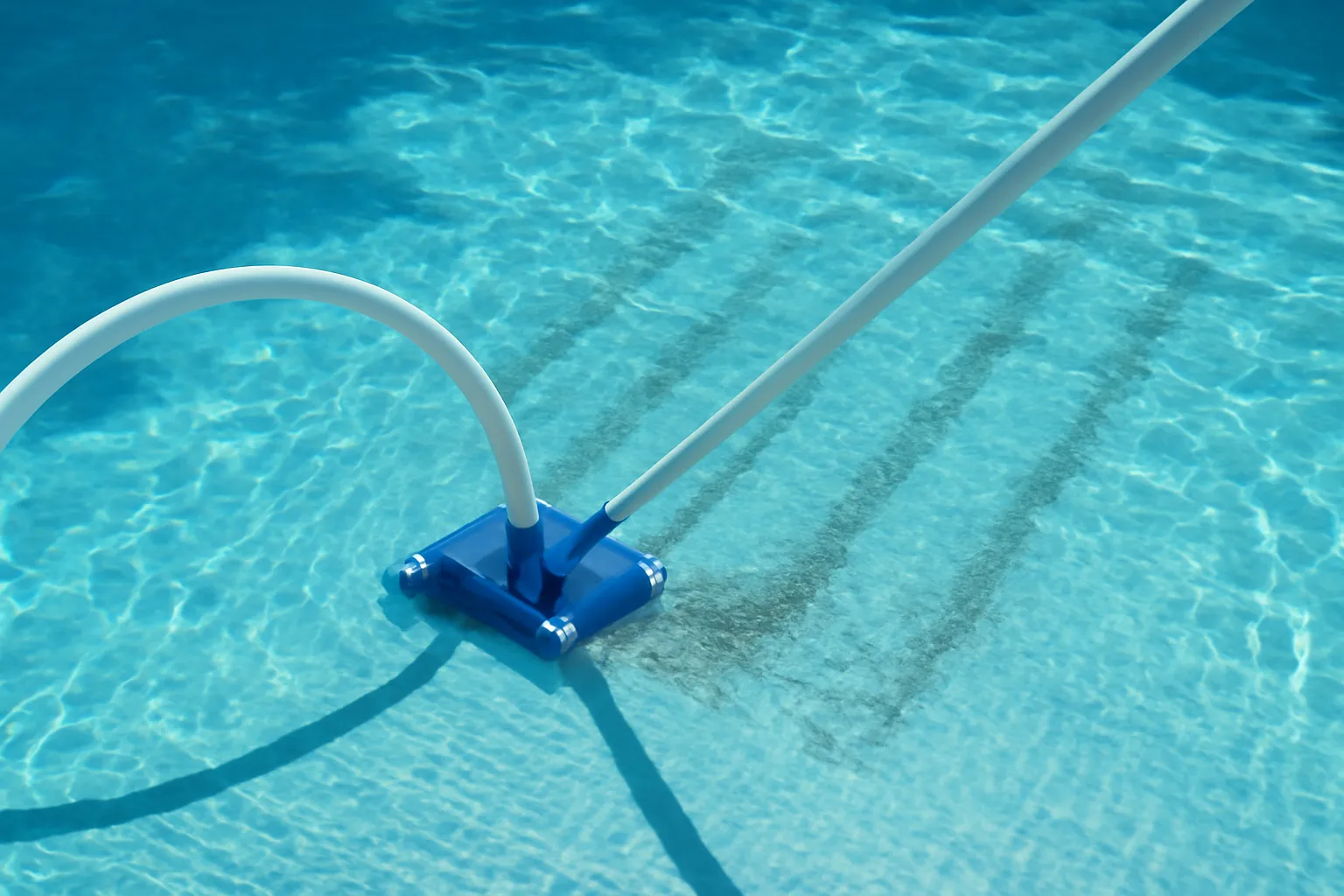
A call came through one Tuesday morning from a property manager in Tempe: “The water looks fine, but the bottom feels gritty. My guy says we don’t need to vacuum because the filter’s running 24/7.” I drove out that afternoon. The pool floor was carpeted in a half-inch layer of silt, algae spores, and decomposed tree matter. The circulation system hadn’t touched it. That gritty feeling? That’s the moment most pool owners realize their assumptions about how pools clean themselves have been wrong all along. The reality is this: manual vacuuming isn’t optional maintenance you skip when things look acceptable — it’s the foundational task that prevents every expensive problem down the line. I’ll walk you through why skipping it costs you money, time, and water chemistry control, and exactly what equipment and technique actually work so you stop making excuses.
Why Debris on Your Pool Floor Destroys Your Chemistry Faster Than You’d Expect
Across my years of chasing water chemistry throughout Arizona, Nevada, and Southern California, the single most common reason a pool’s chemistry spiraled wasn’t user error — it was neglected vacuuming. Here’s the mechanics of what’s actually happening when debris accumulates.
Decomposing organic material — fallen leaves, pollen, dead algae cells, insect bodies, sunscreen oils — generates what gets called chlorine demand. Your free chlorine gets consumed neutralizing that organic load instead of remaining available to sanitize water. I’ve documented cases where free chlorine plummeted from 2.5 ppm to 0.2 ppm within 18 hours on pools where debris had been settling undisturbed. Owners responded by dosing additional chlorine, only to watch it vanish again. The result: $40 to $70 per month evaporating into unnecessary chemical purchases, when the actual problem was sitting on the pool floor.
Structural damage compounds the financial hit. Organic residues decomposing against plaster or concrete surfaces leave stains that demand professional acid washing — typically $250 to $550 to remove depending on depth and surface area. Vinyl liner pools face a different hazard: the weak acids produced as leaves and algae break down actually accelerate liner degradation, potentially cutting a 12-to-15-year liner expectancy down to 7 or 8 years.
Algae blooms represent the catastrophic outcome. What begins as light green tint on the floor and walls escalates into a fully opaque pool in 36 to 60 hours once temperatures hit 83°F or higher — standard conditions across Southwest pool seasons. The remediation clock then starts: shock dosing, sequential pH corrections, multiple filter backwash cycles, possible clarifier treatments. Recovery takes 4 to 6 days minimum. Against that stands 25 minutes of preventive vacuuming, twice weekly. The choice becomes obvious once you run the numbers.
Thorough manual vacuuming using correct equipment and technique eliminates these scenarios entirely. It’s the unglamorous, non-negotiable baseline that supports everything else you do in pool chemistry.
Selecting the Right Vacuum Head, Hose, and Accessories for Your Pool Type
Equipment selection makes or breaks whether you’ll actually stick with a vacuuming routine. Most pool owners don’t realize how dramatically the wrong gear undermines motivation. Let me break down what differentiates functional setups from the ones collecting dust.
Vacuum Head Categories and Performance Differences
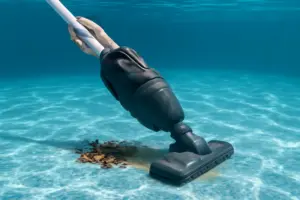
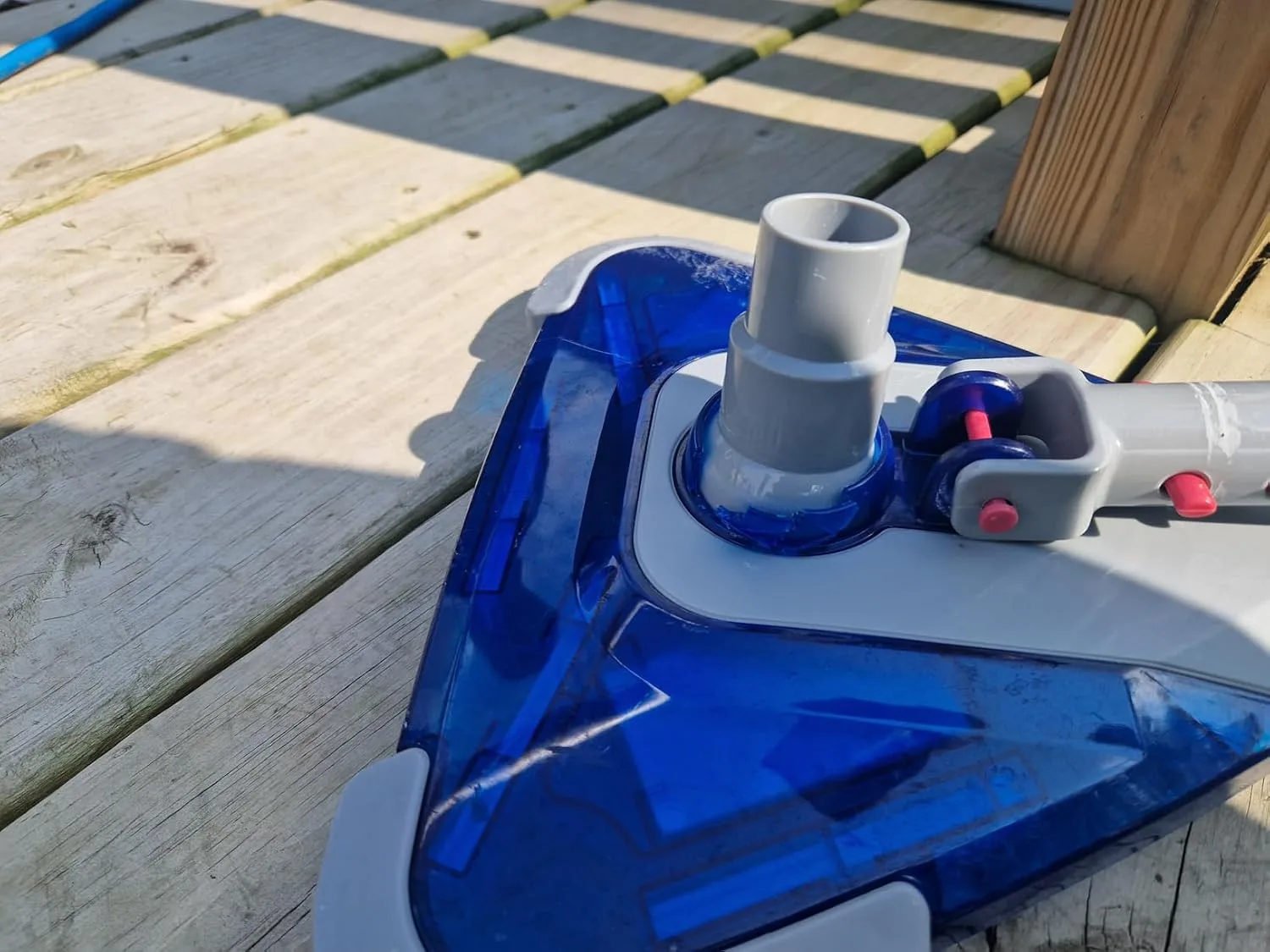
Vacuum head construction falls into distinct categories, each with trade-offs. Basic flat heads with minimal weight constantly bob upward, losing suction mid-stroke — which transforms 20 minutes of work into 45 minutes of frustration. Flexible brush-design heads suit vinyl and fiberglass surfaces because bristles conform to texture without risk of gouging. On concrete and plaster pools, weighted vacuum heads keep firm contact with the floor throughout each pass, maintaining unbroken suction. Wheeled variants introduce gliding mechanics, allowing the head to traverse the floor with negligible drag, which becomes invaluable on larger pools or those with uneven bottoms.
Hose Specifications: Length and Diameter Trade-Offs
This dimension gets overlooked until you’re mid-vacuum and your hose runs out six feet from the deep end. Proper sizing requires adding the longest diagonal span of your pool to its maximum depth. A 15×30 foot pool running 5 feet deep needs approximately 38 feet minimum. Standard residential setups work with 30 to 36 feet. The 1-1/2 inch diameter is conventional for residential pump systems, delivering the suction characteristics most equipment manufacturers calibrated their motors around.
Why Equipment Design Determines Whether Vacuuming Becomes Routine or Gets Abandoned
The single biggest reason pool owners quit vacuuming isn’t time pressure—it’s frustration with equipment that fights back. A head spinning sideways, hose kinking at the valve connection, or wheels that catch on the wall threshold turns routine maintenance into an ordeal. Most owners respond by simply not doing it.
Features that eliminate friction
- Weighted rotatable construction with directional handle stability means the head stays aligned instead of twisting toward the drain and dragging the hose sideways across your deck.
- Extended hose reach—typically 36 feet—eliminates the need to disconnect and reconnect sections mid-job, which is the exact moment most people lose patience and quit.
- Smooth-rolling wheels that track straight and don’t snag on stairs or shallow-end transitions reduce resistance on every stroke, making the work feel easier rather than like pushing against the pool itself.
Legitimate limitations worth acknowledging
- Standard 1-1/2-inch hose diameter was engineered around typical residential pump output—if your circulation system has above-standard suction power, you might forfeit a percentage of potential debris-capture performance on heavier detritus.
- Quality construction and user-experience engineering carry a price premium compared to budget basic kits, so the entry cost is noticeably higher.
I’ll admit: the first time I assembled mine, I was skeptical that weighted handle would actually make a difference—after years of cheap kits twisting on me, I was half-expecting the same old dance. But within the first pass across my deep end, I felt it. This is the equipment that finally made me want to vacuum on schedule. Check out the POOLWHALE Professional 1-1/2-Inch x 36-Feet Swimming Pool Vacuum Hoses and Weighted Rotatable Handle Vacuum Head with Wheels if you’re tired of fighting your vacuum.
About This Article

Written by Nadia Caldwell. Backyard pool owner and water chemistry nerd. After years of chasing down cloudy water and algae blooms on my own pool and my neighbors', I now write about pool maintenance, water treatment, and everything chlorine-related for everyday pool owners. More about this site.
Scope and limits. Nadia is a pool owner who reads chemistry, not a certified pool professional. Follow label directions on every chemical, never mix them, and use a certified pool operator for equipment and sanitizer system work.
Verify this against a primary source
Specifics change, and your situation may differ from the one described here. These are the authorities worth checking directly:
- World Health Organization — guidelines for safe recreational water environments
- Pool & Hot Tub Alliance — water chemistry and pool operation standards