- Turn off power at the breaker — not just the timer. Tag the breaker so no one accidentally restarts it.
- Open all drain plugs on the pump, filter, and heater. Let gravity drain what it can.
- Remove and store the pump drain plug, pressure gauge, and any in-line chlorinator fittings indoors.
- For cartridge filters, remove and clean cartridges, then store them dry indoors. For DE filters, backwash, rinse, and drain fully.
- For gas heaters, follow the manufacturer’s winterization procedure — typically opening drain ports and verifying the heat exchanger is fully drained. Hayward, Pentair, and Raypak all publish model-specific guides; use them.
- Pour a small amount of antifreeze into the pump pot and filter drain ports before closing them — typically 8–12 oz per component.
I learned the hard way that leaving the pump lid seated but not fully sealing the drain plug is a recipe for a cracked volute. The first time I missed a drain plug on a Pentair SuperFlo, I came back in March to a hairline crack along the pump housing. Not catastrophic, but a $180 lesson in double-checking your work before you leave the pad.
Covering the Pool: The Final Step That Matters
A good winter cover does two things: keeps debris out and protects the water chemistry you worked to balance in step one. A bad winter cover creates standing water problems, harbors algae, and can collapse into the pool if not properly secured.
For inground pools, I recommend solid covers with a submersible cover pump set on a timer to remove rainwater accumulation. Water on top of a cover adds weight and stress. In snowy climates, that weight becomes dangerous quickly. For above-ground pools, a cable-and-winch system rated for your pool’s diameter is the standard — ASTM F1346 covers safety cover performance requirements if you’re looking at a safety-rated option.
Place water bags or cover clips every 3–4 feet around the perimeter. Don’t use cinder blocks or bricks — they damage pool decks and can tear covers if they shift. Water bags cost about $8–$12 each and are reusable for several seasons.
When to Call a Pro Instead of DIYing It
I believe in empowering pool owners to handle their own maintenance. However, there are situations where the right call is to hire a licensed pool service contractor (CPO-certified or state-licensed, depending on your jurisdiction).
Call a pro if:
- You have a pool heater with a copper heat exchanger and aren’t sure how to safely drain it — improper draining can cause immediate damage.
- Your pool plumbing includes a suction-side main drain with an anti-entrapment SVRS (Safety Vacuum Release System) — these require specific handling during winterization per ANSI/APSP-7 standards.
- You’ve found any existing cracks, soft spots, or visible plumbing damage before winterizing — closing over existing damage makes spring repairs worse and more expensive.
- Your pool has an attached spa, water features, or a complex manifold system with more than 4–5 valved zones — the risk of missing a dead-leg goes up significantly with system complexity.
- You’re not confident operating a line blower — improper technique can pressurize a plugged line and blow a fitting completely off.
A professional winterization service typically runs $150–$350 for a standard inground pool in most markets. That’s a fraction of the cost of one cracked return line, and it comes with accountability if something goes wrong.
Final Thoughts on Winterize Pool Pipes Cracking Prevention
The step most people skip isn’t dramatic. It’s not technical. It’s just antifreeze in the lines — a $30–$60 investment that stands between you and a $2,000–$5,000 spring repair bill. Winterize pool pipes cracking prevention comes down to understanding what blowing out the lines actually accomplishes (a lot) and what it doesn’t (removing every drop of water from every low point and fitting).
Do the full sequence. Balance the chemistry, lower the water, blow out the lines, add antifreeze, drain and seal the equipment, and cover the pool properly. Don’t assume cold weather is someone else’s problem because you live in the Sun Belt. One hard freeze is all it takes.
The CPDI Champion Pool Antifreeze 4-pack is what I put in my own clients’ pools. That’s the simplest endorsement I can give. Use a product you can trust, follow the sequence, and your plumbing will be waiting for you in the spring exactly the way you left it in the fall.
This post contains affiliate links. As an Amazon Associate, I earn from qualifying purchases at no extra cost to you.
Three winters ago, I got a call from a resort property manager in Scottsdale. She’d had her pool “winterized” by a handyman the previous November. Come February, she was looking at two cracked return lines, a split skimmer body, and a repair bill just north of $4,200. The handyman had drained the pool, covered it, and called it done. Nobody told him — or her — that winterize pool pipes cracking prevention has almost nothing to do with draining the pool itself. It has everything to do with what’s left inside the plumbing afterward.
That story is not unusual. In my years managing pools across Arizona, Nevada, and New Mexico, I’ve walked into dozens of properties where the visible stuff got done and the invisible stuff got ignored. Plumbing that lives underground or inside equipment rooms doesn’t get the same attention as a tarp and a pile of water bags. And that’s exactly where the damage happens.
This post is going to walk you through the step most people skip — antifreeze protection for pool plumbing — and explain exactly why skipping it costs thousands. I’ll cover the full winterization sequence, the products I actually use in the field, and when you should stop and call a licensed contractor instead of pushing through on your own.
Why Pool Pipes Crack in the First Place
Water expands approximately 9% when it freezes. That sounds like a small number until you picture it happening inside a 2-inch Schedule 40 PVC return line with nowhere for that pressure to go. The pipe doesn’t bend. It doesn’t flex. It fractures — usually at a fitting, a union, or a thin-wall section near a pump port.
Most pool plumbing runs at 40–50 PSI during operation. When water freezes inside a sealed section of pipe, the pressure spike can exceed 2,000 PSI locally. That’s not a plumbing system problem. That’s a physics problem, and physics always wins.
Here’s the part that surprises homeowners: you don’t need a hard freeze for this to happen. In my experience, sustained temperatures between 20°F and 28°F overnight — even in climates that only see those temps a few times per year — are enough to crack an unprotected line if water is sitting in a low-flow or dead-leg section of the plumbing. The Southwest is not immune. I’ve seen cracked pipes in Las Vegas and Tucson. Climate doesn’t make you safe. Preparation does.
The Full Winterization Sequence — Done Correctly
A proper pool winterization isn’t one step. It’s a sequence, and each step sets up the next one. Here’s how I run through it on every property I manage.
Step 1: Balance the Water Chemistry First
Before I touch a valve or a plug, I balance the water. Target pH between 7.2 and 7.6, total alkalinity between 80–120 ppm, and calcium hardness between 175–225 ppm for vinyl-lined pools (or 200–275 ppm for plaster). I also shock the pool 48–72 hours before closing with a non-chlorine or cal-hypo shock to knock down organic load.
Unbalanced water sitting all winter causes surface damage and scaling inside the plumbing. That’s a separate repair category from freeze damage, and it’s just as expensive. Do the chemistry first.
Step 2: Lower the Water Level
For most inground pools, I lower the water level 4–6 inches below the skimmer mouth. For pools with mesh safety covers or solid covers with drains, this prevents water from pooling dangerously on top. For above-ground pools, this step matters less, but I still drop it 1–2 inches below the return fittings.
Don’t drain the pool completely unless you’re in a high-water-table area with a specific reason. An empty inground pool — especially fiberglass — can “pop” out of the ground due to hydrostatic pressure. I’ve seen this happen once. It’s as dramatic and expensive as it sounds.
Step 3: Blow Out the Lines
This is where most DIY winterizations start going wrong. I use a commercial-grade shop vac or a dedicated pool line blower — minimum 1.5 HP — to push air through every line: skimmer, main drain, returns, and any spa or water feature plumbing. The goal is to move standing water out of every section.
I blow each line until I see bubbles at the pool return, then immediately plug that return fitting with a winter plug sized to the fitting — typically 1.5-inch or 2-inch rubber expansion plugs. For the main drain, I use a Gizzmo or threaded freeze plug rated for inground applications. Each plug costs $3–$12. Skipping them costs $4,000.
That said, blowing the lines does not remove every drop of water. Low points in the plumbing, dead-legs near valve manifolds, and pump pot housings will still hold residual water. This is exactly why antifreeze is the next step — not an optional add-on.
Winterize Pool Pipes Cracking Prevention: Why Antifreeze Is Non-Negotiable
I’ll be direct: if you live in a region that sees temperatures below 32°F even once per winter, you need pool antifreeze in your lines. Full stop. Blowing out the lines reduces risk. Antifreeze eliminates it for the residual water you can’t physically remove.
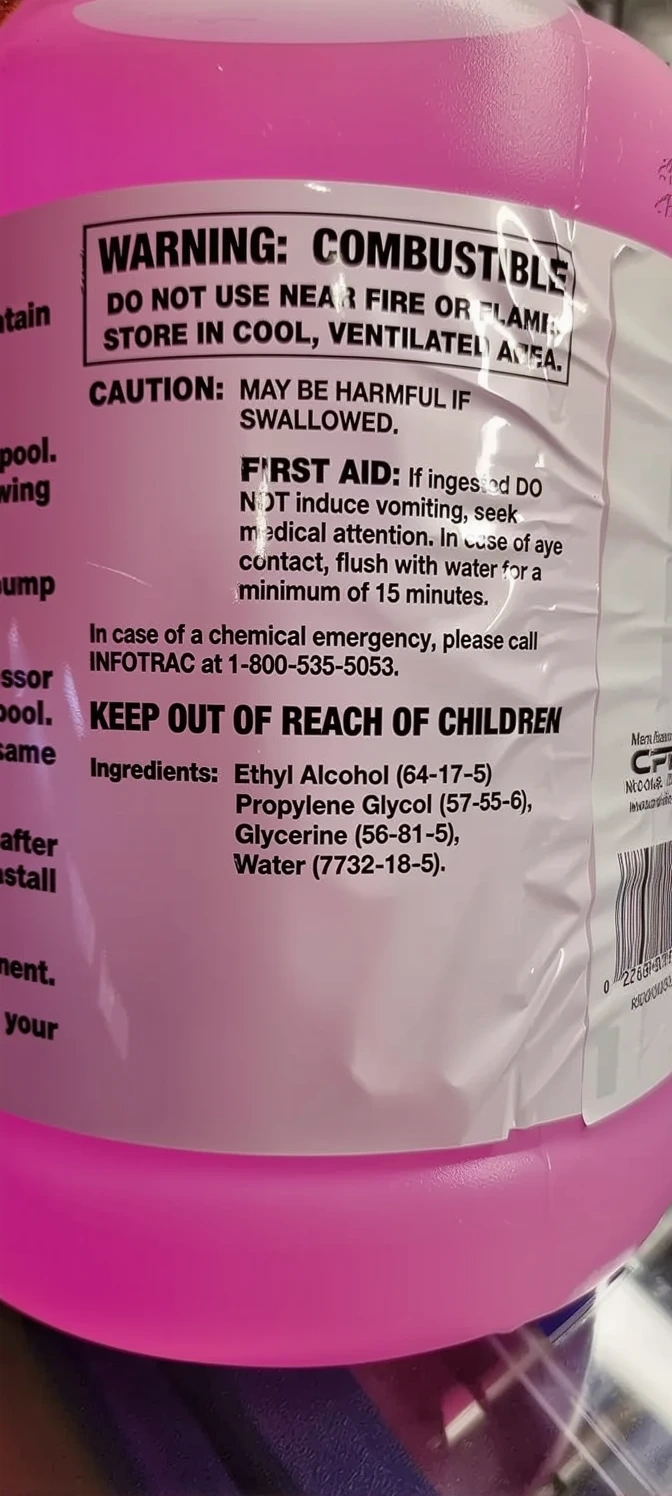
Pool antifreeze is not the same as automotive antifreeze. Do not use automotive antifreeze in pool plumbing. Pool-rated antifreeze is propylene glycol-based — non-toxic, biodegradable, and safe for pool surfaces and equipment seals. Automotive antifreeze is ethylene glycol-based. It will damage your equipment and contaminate your water. I’ve had to explain this to homeowners who thought they were saving money. They were not.
How Much Antifreeze Do You Actually Need?
For a standard inground pool with 1.5-inch plumbing, I calculate roughly one gallon per 10 linear feet of pipe, accounting for any dead-leg sections or spa plumbing. For most residential inground pools, 2–4 gallons covers the return lines, skimmer lines, and equipment connections. For above-ground pools with shorter plumbing runs, 1–2 gallons is usually sufficient.
I pour antifreeze directly into the skimmer after plugging the main drain and returns. Then I use the shop vac — set to blow — to push it through the lines toward the closed plugs, ensuring it reaches every low point in the run. For equipment-side protection, I pour a small amount into the pump pot and filter drain ports before sealing them.
The Product I Rely On Every Season
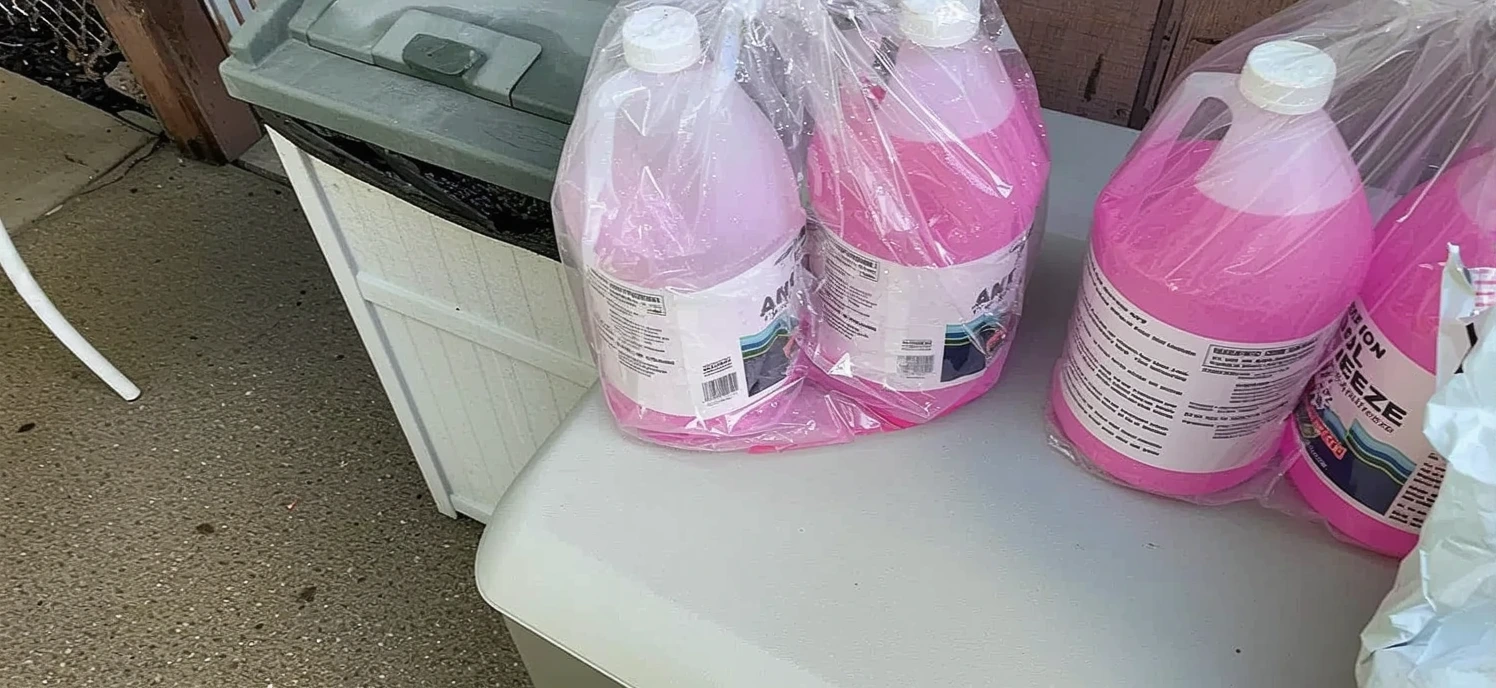
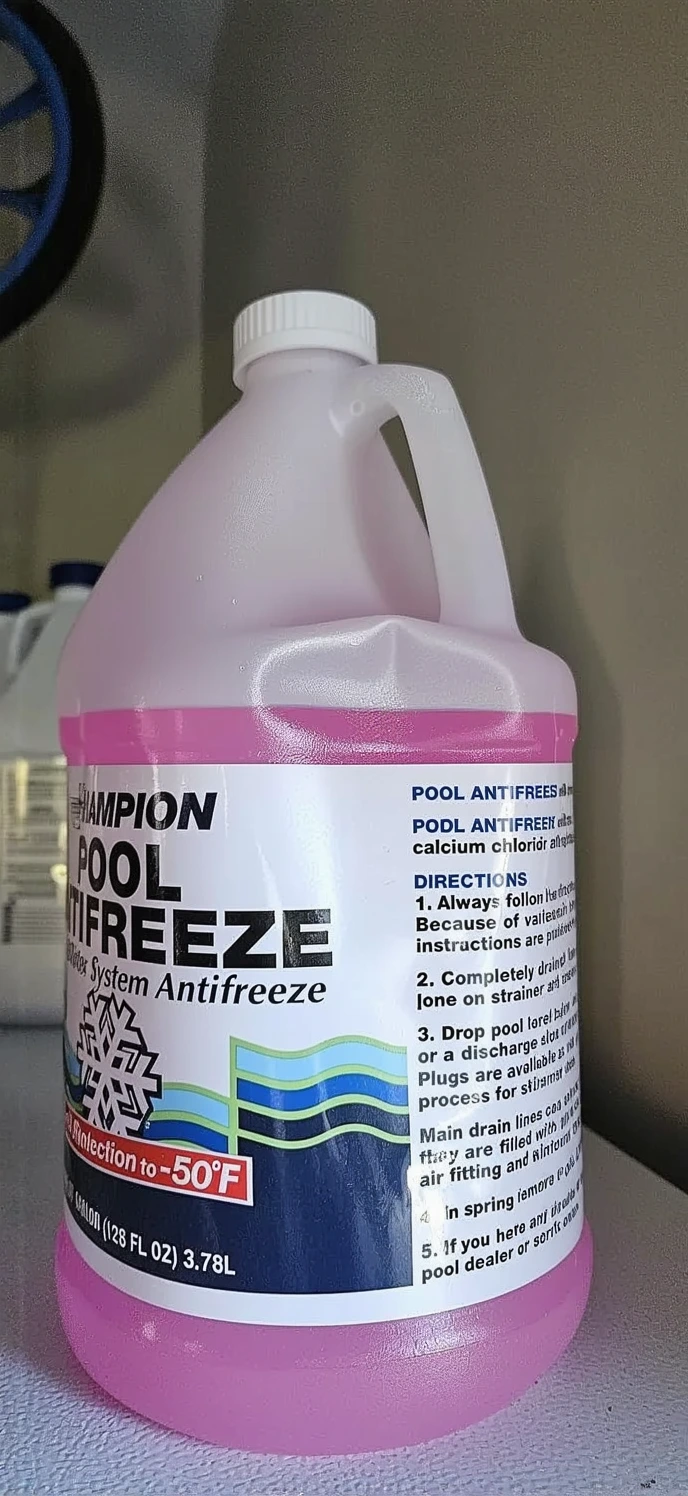
I’ve tested a lot of pool antifreeze products over the years. Some are watery and weak. Others have a shelf life so short they’re practically useless by the time they ship. The one I keep coming back to — and recommend to every property manager I work with — is the CPDI Champion Swimming Pool Antifreeze, available in a 4 x 1 Gallon set.
I started using Champion about four seasons ago after a competitor’s product failed to protect a return line at a HOA community pool outside Flagstaff. We had an unexpected cold snap — 18°F for two nights — and one return cracked despite antifreeze treatment. When I tested the remaining product in the container, the freeze point was nowhere near what the label claimed. That was a $900 repair and a lesson I won’t repeat.
Champion’s formula provides reliable burst protection, and the propylene glycol base is safe for all pool surface types — vinyl, plaster, and fiberglass. It’s also compatible with rubber seals and O-rings in pump and filter equipment, which matters because some cheaper formulas degrade seals over a single winter. The 4-gallon case format is practical for properties with multiple pools or larger inground systems, and the per-gallon price at that quantity is competitive.
Specifically, I appreciate that Champion also advertises rust and corrosion inhibitor properties for metal fittings and heat exchanger components. For pools with gas heaters — where copper headers and brass fittings are common — this is worth the price difference over generic options.
If you’re managing a single above-ground pool or working with a tighter budget this season, the TradeGrade Spa and Pool Antifreeze is a solid runner-up. It covers both inground and above-ground applications, protects to 50°F freezing point, and comes in a 4-gallon set. I’ve used it on smaller residential accounts with good results. For critical infrastructure or commercial properties, however, I stay with Champion.
Equipment Winterization: Don’t Forget the Pump and Filter
Pipes get the most attention, but equipment failures are just as costly. A cracked pump housing runs $150–$400 in parts alone, not counting labor. A fractured filter tank can run $600–$1,200 to replace.
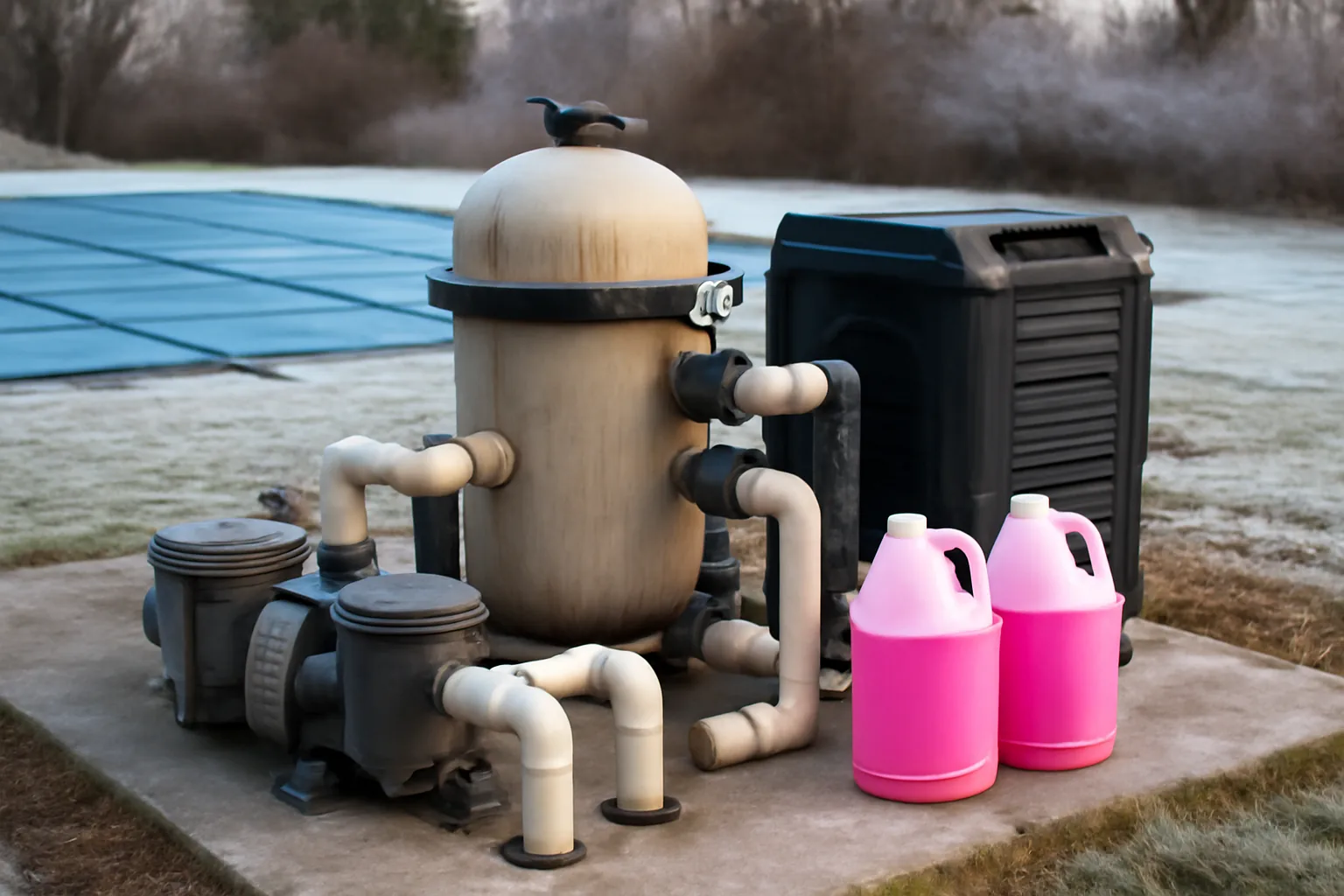
Here’s my equipment winterization sequence:
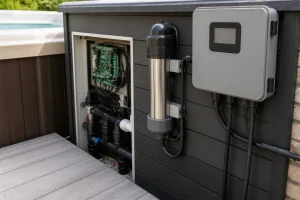
- Turn off power at the breaker — not just the timer. Tag the breaker so no one accidentally restarts it.
- Open all drain plugs on the pump, filter, and heater. Let gravity drain what it can.
- Remove and store the pump drain plug, pressure gauge, and any in-line chlorinator fittings indoors.
- For cartridge filters, remove and clean cartridges, then store them dry indoors. For DE filters, backwash, rinse, and drain fully.
- For gas heaters, follow the manufacturer’s winterization procedure — typically opening drain ports and verifying the heat exchanger is fully drained. Hayward, Pentair, and Raypak all publish model-specific guides; use them.
- Pour a small amount of antifreeze into the pump pot and filter drain ports before closing them — typically 8–12 oz per component.
I learned the hard way that leaving the pump lid seated but not fully sealing the drain plug is a recipe for a cracked volute. The first time I missed a drain plug on a Pentair SuperFlo, I came back in March to a hairline crack along the pump housing. Not catastrophic, but a $180 lesson in double-checking your work before you leave the pad.
Covering the Pool: The Final Step That Matters
A good winter cover does two things: keeps debris out and protects the water chemistry you worked to balance in step one. A bad winter cover creates standing water problems, harbors algae, and can collapse into the pool if not properly secured.
For inground pools, I recommend solid covers with a submersible cover pump set on a timer to remove rainwater accumulation. Water on top of a cover adds weight and stress. In snowy climates, that weight becomes dangerous quickly. For above-ground pools, a cable-and-winch system rated for your pool’s diameter is the standard — ASTM F1346 covers safety cover performance requirements if you’re looking at a safety-rated option.
Place water bags or cover clips every 3–4 feet around the perimeter. Don’t use cinder blocks or bricks — they damage pool decks and can tear covers if they shift. Water bags cost about $8–$12 each and are reusable for several seasons.
When to Call a Pro Instead of DIYing It
I believe in empowering pool owners to handle their own maintenance. However, there are situations where the right call is to hire a licensed pool service contractor (CPO-certified or state-licensed, depending on your jurisdiction).
Call a pro if:
- You have a pool heater with a copper heat exchanger and aren’t sure how to safely drain it — improper draining can cause immediate damage.
- Your pool plumbing includes a suction-side main drain with an anti-entrapment SVRS (Safety Vacuum Release System) — these require specific handling during winterization per ANSI/APSP-7 standards.
- You’ve found any existing cracks, soft spots, or visible plumbing damage before winterizing — closing over existing damage makes spring repairs worse and more expensive.
- Your pool has an attached spa, water features, or a complex manifold system with more than 4–5 valved zones — the risk of missing a dead-leg goes up significantly with system complexity.
- You’re not confident operating a line blower — improper technique can pressurize a plugged line and blow a fitting completely off.
A professional winterization service typically runs $150–$350 for a standard inground pool in most markets. That’s a fraction of the cost of one cracked return line, and it comes with accountability if something goes wrong.
Final Thoughts on Winterize Pool Pipes Cracking Prevention
The step most people skip isn’t dramatic. It’s not technical. It’s just antifreeze in the lines — a $30–$60 investment that stands between you and a $2,000–$5,000 spring repair bill. Winterize pool pipes cracking prevention comes down to understanding what blowing out the lines actually accomplishes (a lot) and what it doesn’t (removing every drop of water from every low point and fitting).
Do the full sequence. Balance the chemistry, lower the water, blow out the lines, add antifreeze, drain and seal the equipment, and cover the pool properly. Don’t assume cold weather is someone else’s problem because you live in the Sun Belt. One hard freeze is all it takes.
The CPDI Champion Pool Antifreeze 4-pack is what I put in my own clients’ pools. That’s the simplest endorsement I can give. Use a product you can trust, follow the sequence, and your plumbing will be waiting for you in the spring exactly the way you left it in the fall.
This post contains affiliate links. As an Amazon Associate, I earn from qualifying purchases at no extra cost to you.