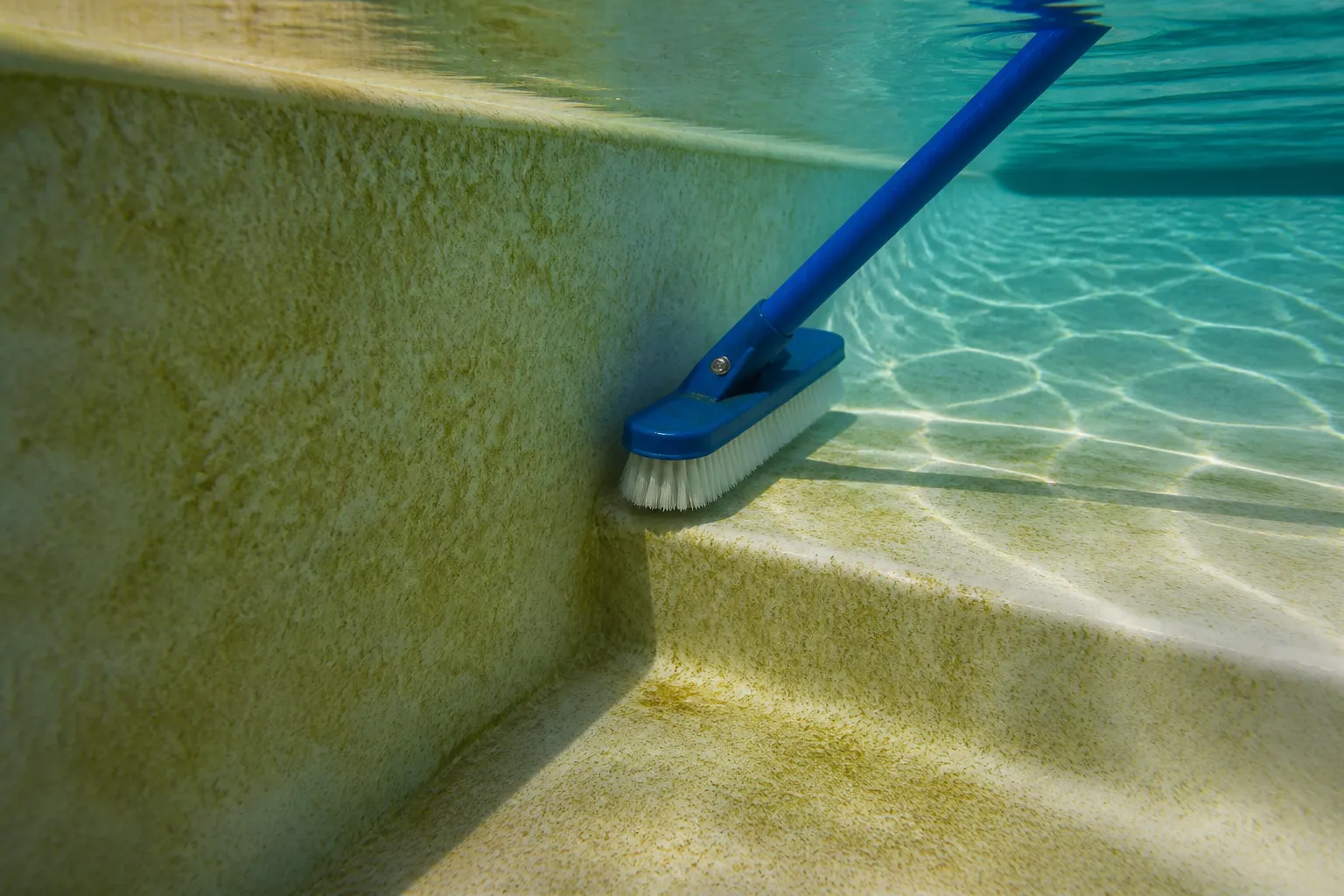
Every spring (and honestly, most of the year in the desert) someone tells me the same story. They shocked the pool on Saturday, the water looked perfect Sunday morning, and by the following Wednesday there’s that same dull yellow-brown film creeping back along the shady wall. Their conclusion is always the same: “The chlorine must be bad.” So they buy more, shock again, and repeat the cycle all season. The short version of the answer: mustard algae is not a chlorine-quality problem. It’s a shade-loving organism that tolerates far more chlorine than green algae does, and it comes back from whatever you didn’t sanitize. A successful mustard algae treatment means fixing your water chemistry first, holding chlorine at a sustained level, and cleaning everything that touched the pool.
Why a shock that works on green algae leaves mustard algae behind
Green algae is the easy case. It floats in the water column, it’s exposed to sunlight, and it’s relatively fragile. Hit it with a proper shock and you’ll see the water go from pea-soup to clear over a day or two, and the organism is actually dying off. Mustard algae doesn’t play by those rules. It’s chlorine tolerant to a degree that surprises most owners, and it’s adapted to live where the chlorine is weakest rather than where it’s strongest.
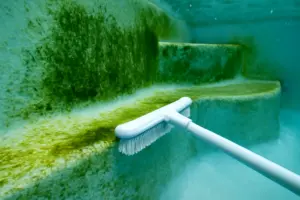
Here is the mechanism that matters. Mustard algae grows as a film that clings to surfaces, especially shaded ones: the side wall that never sees direct sun, the corner behind the ladder, the underside of the steps, the deep-end floor in the shadow of a cover or a tree. Those are exactly the places where free chlorine is lowest, because the intense sun burns chlorine off the sunlit water fastest, and the shaded surfaces get the least circulation. A shock dose knocks the visible color back, the water looks crystal clear, and a surviving population sits quietly on the shaded wall. Four days later, with the chlorine residual back down, it repopulates.
This is why “the shock didn’t work” is usually the wrong read. The shock did something. It just didn’t finish the job, and you can’t tell from the water alone. The organism is a film, not a cloud, so clear water tells you very little about whether it’s gone. In my experience the owners who get stuck in this loop are the ones who judge success by how the water looks rather than by whether the film is actually gone.
Mustard algae vs. green and black algae: identifying what you actually have
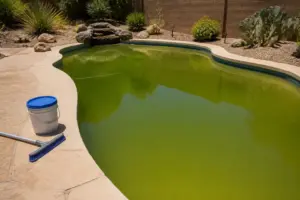
Misidentification is the root of most failed treatments, so start here. Mustard algae is yellow-brown to dull ochre, it feels powdery or like fine sand rather than slimy, and it brushes off in a cloud with almost no resistance. That last point is the trap: because it comes off so easily, owners assume they’ve killed it. It’s also commonly mistaken for pollen, desert dust, or a stain. Two quick field tests will settle most cases. First, brush a patch and watch it for three days. Dust and pollen won’t regrow on the same spot; mustard algae will. Second, check where it starts. Mustard algae shows up first on shaded surfaces. Green algae blooms through the whole water column and clouds the water. Mustard algae usually leaves the water clear, which is another reason owners doubt it’s algae at all.
The table below is the quick version I use when a neighbor asks me what they’re looking at. If you’re unsure, it’s worth comparing before you commit to a treatment, because the wrong treatment is wasted chemistry.
| What you are looking at | Green algae | Mustard algae | Black algae |
|---|---|---|---|
| Colour and texture | Green, slimy or fuzzy | Yellow-brown, powdery | Dark black spots, embedded |
| Where it appears first | Whole water column | Shaded walls and corners | Plaster, tile lines, rough spots |
| Chlorine tolerance | Low | High | Very high |
| Does brushing alone remove it | Mostly, with shock | Brushes off but regrows | No, roots into surface |
| What actually kills it | Sustained shock | Sustained chlorine plus pH control | Long-term chemistry and stainless brushing |
| Typical time to clear | Days | 1–2 weeks with proper follow-through | Weeks to months |
The row that matters most is “chlorine tolerance.” Mustard algae’s high tolerance is the single reason a shock that clears green algae can leave it standing. If you’ve been running textbook green-algae treatments on yellow film and getting nowhere, that row explains why.
The step-by-step mustard algae treatment that holds
The order of these steps is the whole point. Skipping ahead, especially past the chemistry, is what causes relapse.
- Test and correct pH first. Before you add anything, get your pH into the 7.2–7.4 range. At that level a much larger share of your free chlorine is in the form that actually does the killing. At pH 8.0, the same free chlorine reading is dramatically weaker. Shocking a high-pH pool is the most common reason an adequate dose underperforms, so fix this before you spend money on chemicals.
- Check cyanuric acid (CYA). Be blunt with yourself here. If CYA has built up over a season of trichlor tablets, the free chlorine you need to get a real oxidizing effect rises with it. A shock that works fine at 30 ppm CYA does very little at 100 ppm. If CYA is high, the fix is a partial drain and refill, not more shock. If you haven’t read my post on cyanuric acid and chlorine lock, start there before you dose again.
- Brush the affected surfaces first. You want the sanitizer reaching the organism, not sitting on top of a film. Use a nylon brush with a wide, soft head on a sturdy pole. Unlike black algae, mustard algae isn’t embedded in the plaster, so you don’t need a stainless brush to break into it. Stainless on plaster can scuff the surface, so save it for the stubborn black stuff.
- Hold an elevated free chlorine level over time. One shock dose decays fast, and this organism survives short exposure. Aim for a sustained residual over a day or more, retesting and topping up as needed, rather than firing a single dose and walking away. Sustained exposure is what separates a treatment that holds from one that relapses.
- Run the pump continuously through the treatment. Circulation keeps the chlorine moving into the shaded zones that otherwise stay low. Brush the shaded surfaces daily during the treatment, not just once at the start.
- Sanitize every piece of equipment in the same window. Soak brushes, vacuum heads, hoses, skimmer and pump baskets, toys and floats in chlorinated water or a chlorine solution. Wash swimsuits and towels. This is the step everyone skips, and it’s the one that makes the difference, which I’ll cover in the next section.
- Clean or backwash the filter at the end. The filter has been collecting the organism the whole time. A dirty filter is a reservoir that will reseed the pool, so backwash or clean it once the treatment is done.
On yellow-out products: you’ll see sodium bromide products sold specifically for mustard and yellow algae. They work by converting your existing chlorine into bromine, which is more effective against this organism. The tradeoffs the label doesn’t dwell on: the bromide consumes free chlorine, so it has to be paired with a shock rather than used instead of one; it turns the pool temporarily into a bromine pool, so your chlorine readings and routine behave oddly until the bromide dilutes out (which is driven by water replacement, not time); and it’s a poor choice on a saltwater pool, because the salt cell will keep regenerating bromine from the bromide and you lose the chlorine system you paid for until most of the water is replaced. My verdict is that it’s effective, but it’s a one-time tool for a stubborn case, not a seasonal routine, and I wouldn’t use it on a salt pool. If you’re unsure, follow the manufacturer’s instructions and check with a qualified pool service before you run it.
The reinfection trap: why it keeps coming back
Here is the part that everyone skips, and it’s the single most useful thing in this post. Mustard algae survives on anything that was in the water and stayed damp. You can run a textbook treatment on the water and then reintroduce the organism the same afternoon with the brush you used during the treatment. Every surface and object that touches the pool is a potential carrier: pool toys and floats, the brush and vacuum head, vacuum hoses, the skimmer and pump baskets, steps and ladder treads, swimsuits and towels, a solar cover and its roller, the underside of an automatic cover, and the inside of the filter. If any of these go back into the pool un-sanitized, you’ve reseeded the problem.
I helped a family member with their pool a couple of seasons back, and the recurring patch on their shady wall came back on the same schedule every time. We finally traced it to the vacuum head. They were treating the water, brushing the wall, and then rinsing the head in the garden hose and dropping it right back in. That head was the carrier. Once they started soaking all their equipment in chlorine solution during treatment, the patch stopped coming back. This is why repeat failure is the norm with this organism, and why “my chlorine must be bad” is the wrong conclusion. Your chlorine is probably fine. Your equipment is probably the problem.
Desert and Arizona conditions make it worse
If you’re in Arizona or anywhere similar, the conditions stack against you in ways that are hard to fight. Blowing dust and monsoon storms deposit organic material and spores continuously, so you’re re-inoculating the pool all the time. Water temperatures above the high 80s raise your sanitizer demand at the same time they speed growth. A swim season that runs most of the year means tablet-fed pools accumulate cyanuric acid far higher than they would in cooler climates, which is exactly the condition that makes shock underperform. And the intense sun burns free chlorine off the sunlit surfaces fastest, while the shaded wall where mustard algae lives stays the lowest-chlorine real estate in the whole pool.
So in desert conditions you need to be more deliberate, not less. Keep an eye on CYA, keep pH in range, and expect to brush the shaded surfaces more often. If you’re dealing with a full-blown green bloom rather than the yellow film, my desert green pool recovery post is the companion piece to this one, since the two often show up together.
Mistakes that cause relapse or permanent damage
The most common mistake is stopping when the water looks clear. Clear water is not proof the film is gone. Keep the sustained chlorine level going and brush the shaded surfaces until the film is physically gone, which usually means several days, not one. Stopping early is how you end up re-shocking every four days all season.
The second mistake is reaching for stainless steel brushes on plaster out of habit from black algae work. Mustard algae doesn’t need it, and aggressive brushing on plaster or pebble finishes can etch the surface and leave rough patches that the organism loves to colonize later. Use nylon for this.
The third mistake, and the one that’s commonly recommended elsewhere but is wrong here, is adding more shock without fixing pH and CYA first. Dumping extra chemical into a high-pH, high-CYA pool is expensive and often ineffective, and it can push your readings into an unpleasant range that makes the water harder to balance. Fix the chemistry before you add volume. The other common bad idea is dumping a product straight into the pool without checking whether it conflicts with the salt system or whether it needs a shock to be effective.
Finally, don’t let the filter become a reservoir. Skipping the backwash at the end of a treatment is a quiet way to guarantee the problem returns.
Frequently Asked Questions
Is mustard algae harmful to swim in?
Mustard algae is not considered a serious health hazard in the way some bacterial problems are, but you shouldn’t swim in a pool with a visible film on it. It can make the water and surfaces unpleasant and slippery, and it’s a sign your sanitizer isn’t keeping up. Treat it before swimming, and if you have any health concerns, check with a doctor or local health authority.
How do I tell mustard algae from pollen or desert dust?
Brush the patch and watch it for three days. Pollen and dust won’t regrow in the same spot, but mustard algae will, usually on shaded surfaces first. It also feels powdery and brushes off easily, which is why people mistake it for dust, but the regrowth test is the most reliable check.
Why does mustard algae keep coming back after I shock the pool?
Shock clears the visible color, but a surviving population remains on shaded walls and corners where chlorine is lowest. It also survives on toys, brushes, vacuum heads, and baskets that go back into the water un-sanitized. Fix pH and cyanuric acid, hold sustained chlorine, and sanitize all your equipment to stop the cycle.
Can I use a yellow-out product in a salt water pool?
It’s generally a poor choice. Sodium bromide products convert chlorine to bromine, and a salt cell will keep regenerating bromine from the bromide, so you can lose your chlorine system until much of the water is replaced. Check your equipment manufacturer’s guidance and consider a professional opinion before using one on a salt pool.
How long does a proper mustard algae treatment take?
A correct treatment usually takes one to two weeks of sustained chlorine, daily brushing of shaded surfaces, and equipment sanitizing. The water may look clear in a day or two, but you need to keep going until the film is physically gone and stays gone. Stopping when the water looks clear is the most common reason the problem returns.
The Bottom Line on mustard algae treatment
A real mustard algae treatment is a chemistry-and-equipment job, not a single shock. Fix pH and cyanuric acid first, so your chlorine can actually work. Hold a sustained free chlorine level, brush the shaded surfaces daily, run the pump, and sanitize every piece of gear that touches the water. Then keep it that way. If the patch comes back in the same spot, treat it as a reinfection problem, not a dosing problem, and go look at what you’ve been putting back in the pool.
The exception is the stubborn case that won’t clear after a proper, sustained treatment. That’s when a sodium bromide yellow-out product becomes worth considering, provided you don’t have a salt pool. For anything that stays stubborn past that, or if you’re not sure what you’re looking at, get a professional test and a second opinion. I’m a backyard owner who has learned this the hard way, not a pool professional, and some situations need someone with the right gear and training on the ground.
About This Article
Written by Nadia Caldwell. Backyard pool owner and water chemistry nerd. After years of chasing down cloudy water and algae blooms on my own pool and my neighbors', I now write about pool maintenance, water treatment, and everything chlorine-related for everyday pool owners. More about this site.
Scope and limits. Nadia is a pool owner who reads chemistry, not a certified pool professional. Follow label directions on every chemical, never mix them, and use a certified pool operator for equipment and sanitizer system work.
Verify this against a primary source
Specifics change, and your situation may differ from the one described here. These are the authorities worth checking directly:
- World Health Organization — guidelines for safe recreational water environments
- Pool & Hot Tub Alliance — water chemistry and pool operation standards