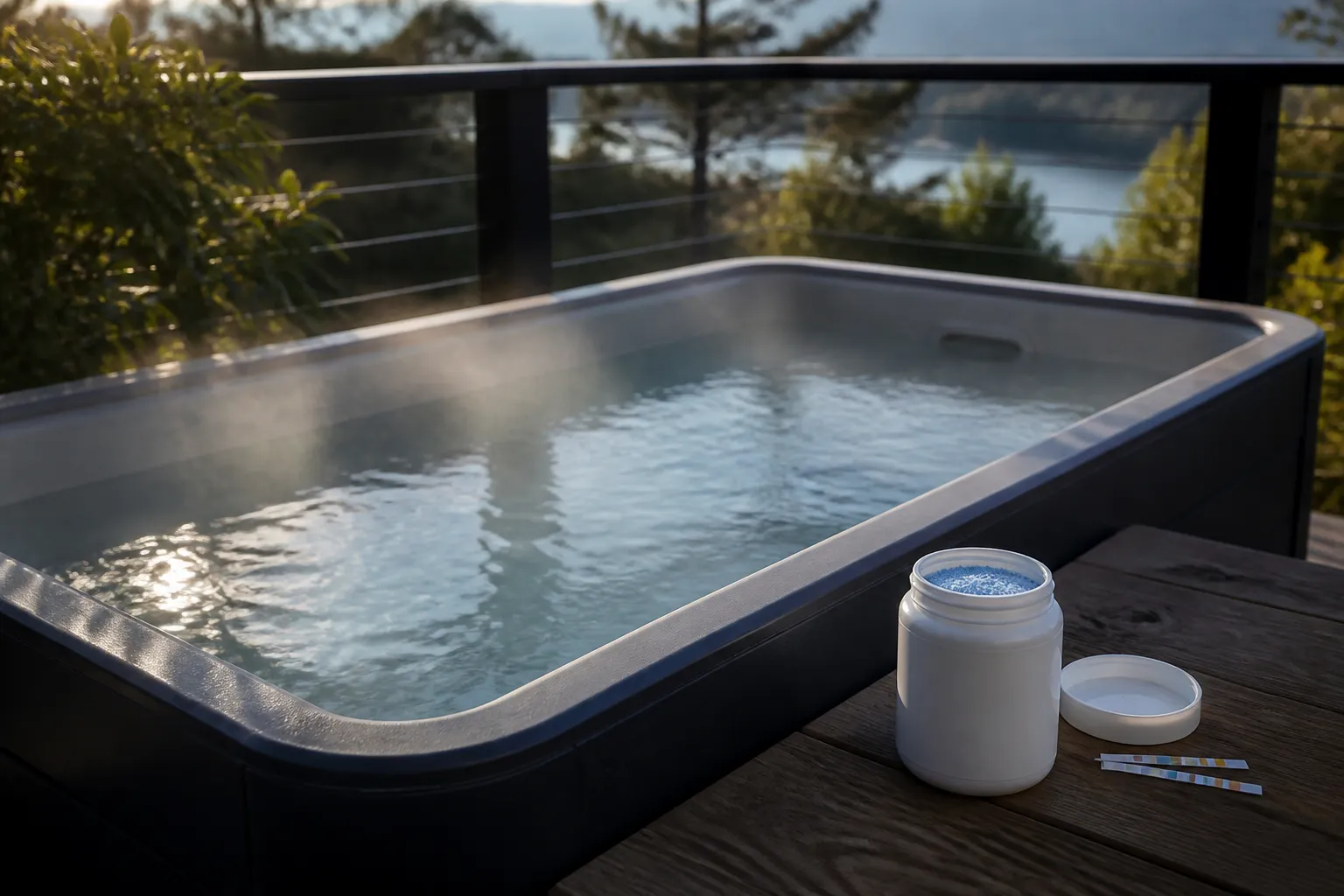
I’ve been looking after pools and spas around Arizona and New Mexico for nearly a decade, and I can tell you that the single most frequent mistake I see with cold plunge tubs has nothing to do with temperature control—it’s sanitizer choice. Pool owners spend hours reading about bromine vs chlorine for hot tubs, find endless guidance pointing them toward bromine, and then buy a cold plunge tub running at 45°F and wonder why the same advice suddenly fails them.
Before you add anything: follow the dose on the label, add one chemical at a time, and never mix them — not in a bucket, not in the skimmer, not back to back in the same spot. Chlorine and acid together give off chlorine gas, which is the one mistake in pool care that puts people in hospital. Always add chemical to water, never water to chemical, and let the pump turn the water over between doses.
Here’s the inversion nobody talks about: everything those hot tub guides tell you about bromine’s superiority rests on one thing—temperature stability. At 104°F, chlorine volatilizes and burns off fast. Bromine’s greater stability in hot water makes it worth the higher cost and the drawbacks. But a cold plunge? It runs at 39–55°F. Chlorine doesn’t gas off in cold water. It stays put. It holds a residual for days instead of hours. The single strongest argument for bromine evaporates the moment the water temperature drops, and suddenly you’re paying more for a product that performs worse in the exact conditions you’re using it for.
I’m going to explain why chlorine is the right call for your cold plunge, why bromine specifically fails in cold water, and exactly how to set up a maintenance routine that actually works for a small, heavily loaded tub. Because a cold plunge isn’t just a tiny hot tub—it’s a completely different chemistry problem.
Why This Problem Is Worse Than You Think
Most cold plunge owners assume cold water is “cleaner.” It’s not. That’s the first mistake, and it’s the foundation of everything else that goes wrong.
Cold water slows bacterial growth, yes. It does not kill bacteria. It does not sanitize. What it does is suppress the growth rate—which means a poorly sanitized cold plunge looks perfectly clear while hosting a thriving biofilm in the pipework and potentially problematic microbial loads in the water itself. The person who plunges on day two of bad maintenance won’t get sick from what they see. They might get sick from what they don’t.
But here’s the real problem: bather load per gallon. A typical cold plunge holds 80–150 gallons. A person entering it brings the same sweat, skin oils, lotion, cosmetics, and organic load they’d bring into a 400-gallon spa or a 20,000-gallon pool. Except here, it’s concentrated into almost nothing. The organic load per gallon in a cold plunge is the highest of any residential water feature—often 100+ times higher than a large pool on a per-gallon basis.
Add to that: people plunge immediately after workouts, saunas, or gym sessions. Peak organic input. And they plunge in rapid succession—one person every few minutes during a wellness routine or group session. That small volume swings fast. A cold plunge that looks clear at 8 a.m. can be badly under-sanitized by 8:15 a.m.
Chemical disinfection is temperature-dependent across the board. Pathogen inactivation takes measurably longer at 45°F than at 80°F—we’re talking hours instead of minutes for the same kill rate. That means a cold plunge needs a higher maintained free chlorine residual than an equivalent-size warm tub would, not a lower one. It needs more contact time after dosing. And it needs testing before every session, not weekly.
Bromine’s one real advantage is hot-water stability. A cold plunge has no hot water. In cold water, bromine’s bromide-to-bromine conversion reaction slows to a crawl. The system is slow to establish a residual and slow to recover after bather load—exactly the wrong behavior when you need fast protection in a tiny, heavily loaded volume. You’re paying 30–40% more per dose for a product that works slower in the exact conditions it’s supposed to work in.
What to Look For in a Cold Plunge Chlorine System
The right tool for a cold plunge is granular dichlor—not tablets, not liquid, and definitely not bromine. Here’s why, and what to look for.
Dissolution Rate in Cold Water
Trichlor tablets—the standard for pools and hot tubs—dissolve slowly in cold water. At 45°F, a trichlor tablet can sit in a floater for hours with minimal breakdown. Dichlor granules dissolve in seconds. That matters enormously in a cold plunge because you need a rapid residual recovery after bathers load the tub, not a slow rise over the course of an afternoon.
Leisure Time E5, Spa 56 Chlorinating Granules for Spas and Hot Tubs (5 lbs, $29.70) is formulated as a stabilized dichlor product with a 56% available chlorine content and built-in cyanuric acid. It’s designed specifically for spas where small volume and precision matter. The granule size is fine enough to dissolve quickly in a plunge tub without creating cloudiness, and the package size is right—you’re not buying a 25-lb bucket that will expire before you use it.
pH Neutrality
Dichlor is pH-neutral to slightly alkaline (typically 6.5–7.0 pH in solution). That matters for a small tub because you don’t have a huge water volume to buffer pH swings. Liquid chlorine and cal-hypo are both aggressive pH-shifters. With a cold plunge holding 100 gallons, a miscalculation with either one can swing your pH 0.5–1.0 point in a single dose. Dichlor lets you sanitize without constant pH correction.
Precision Dosing for Small Volumes
Granular dichlor lets you measure small quantities. You can dose 1–2 teaspoons for a 100-gallon tub and know exactly what you’re adding. A trichlor tablet? You’re committed to whatever dose that tablet represents, and it’s too much for most cold plunges when added all at once. Precision matters in a small volume.
The Honest Limitation: CYA Accumulation
Dichlor contains cyanuric acid (stabilizer). Every dose adds a small amount. In a large pool with regular water changes, this isn’t a problem. In a 100-gallon cold plunge that you’re carefully maintaining, CYA builds up fast. You’ll hit 100+ ppm CYA within a few weeks of regular use, and high CYA locks up your chlorine and reduces its effectiveness—a phenomenon called chlorine lock. This is the reason cold plunges need periodic full water drains regardless of how well they’re sanitized. Typically every 4–8 weeks depending on use, you’ll need to drain and refill to reset your CYA. That’s the tradeoff for precision dosing and rapid dissolution. It’s worth it, but you need to know about it.
How to Use It Like a Pro
Years of small-volume water taught me that small-volume systems need a different maintenance mindset than pools. Here’s the routine that actually works.
Dosing and Residual Targets
Target a free chlorine residual of 3–5 ppm for a cold plunge—higher than you’d maintain in a pool (1–3 ppm), but aligned with high-use spa guidance. Cold water slows disinfection, and bather load is extreme per gallon. Test before every plunge session, not weekly. A 100-gallon tub with five people entering it in an hour can drop from 4 ppm free chlorine to 1–2 ppm. You need to know that before person six gets in.
For dosing, use this rule of thumb: 1 teaspoon of dichlor granules raises free chlorine approximately 5–6 ppm in 100 gallons. Adjust based on your test strips. Dissolve the granules in a small cup of water first to speed uptake and prevent spotting on the tub surface.
Testing with the Right Tools
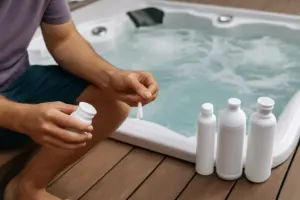
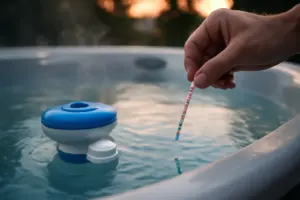
Use test strips or a kit rated for spa water (0–10 ppm free chlorine range), not pool strips. Pool strips often cap out at 5 ppm and won’t give you readable results in the 3–5 ppm range you’re targeting. Buy two strips per test—one for free chlorine, one for total chlorine. If total chlorine significantly exceeds free chlorine (more than 0.5 ppm difference), you have chloramines (combined chlorine), which means the residual isn’t doing its job and you need a shock treatment. For a cold plunge, a partial water change is often faster than a chemical shock.
Cover and Circulation
Keep the tub covered when not in use. An uncovered plunge loses chlorine to UV, collects pollen and debris continuously, and cold water sitting exposed breeds biofilm in the lines. Run any circulation or filtration daily, even if nobody’s plunging. Stagnant water is stagnant water, and cold doesn’t prevent biofilm—it just slows the growth rate.
Common Mistakes
Don’t assume a clear-looking tub is clean. Don’t skip testing because “it was fine yesterday”—bather load can change everything in hours. Don’t use trichlor tablets; they won’t dissolve properly. Don’t buy a year’s supply of dichlor; it has a shelf life of 3–5 years and degrades faster once opened. And don’t buy a “chemical-free” plunge tub expecting it to stay clean without a residual sanitizer—I’ll cover that next.
Pairing It With the Rest of Your Routine
A cold plunge chlorine system doesn’t stand alone. It sits within a larger maintenance picture.
Ozone, UV, and Filtration as Supplements
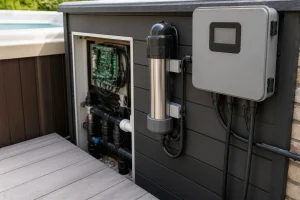
Many purpose-built cold plunge units ship with ozone, UV, or filtration-only systems marketed as “chemical-free.” These do have value—they reduce the demand on your chlorine residual by treating water as it circulates. But they’re not a replacement for a measurable residual in the tub.
Here’s why: ozone and UV treat only the water that physically passes through the treatment chamber. Neither one leaves a residual in the tub itself. That means ozone or UV protects you from the person who was in the tub with you, but not from the person who was in it twenty minutes ago if that contact time already elapsed. In a high-bather-load situation—which a cold plunge is—that’s a real gap. Use ozone or UV if your tub has it, but maintain a chlorine residual anyway. The two work together; neither replaces the other.
Hydrogen Peroxide: Why It Doesn’t Work Here
Hydrogen peroxide comes up constantly in cold plunge forums as a “natural” alternative. It’s not reliable as a primary sanitizer for this application. It’s difficult to test accurately at the low concentrations used in water features, it has no lasting residual at practical doses, and it degrades quickly in water exposed to light. For a small, heavily loaded tub, you need a measurable, persistent residual, and hydrogen peroxide doesn’t deliver that.
Water Change Frequency
Plan on a full drain and refill every 4–8 weeks, driven by CYA accumulation and total dissolved solids (TDS) rather than by how the water looks. Many owners are surprised by how fast CYA builds—you can hit 80–100 ppm in a month with regular dichlor use in a small volume. At that point, chlorine effectiveness drops significantly and a water change is necessary, even if the water is crystal clear and the residual tests normal.
Some owners run a partial drain-and-refill (25–30% volume) every 2 weeks as routine maintenance, then a full drain every 6 weeks. That works too. The key is tracking CYA—get a cyanuric acid test kit or use strips that measure it, and make the full drain your decision point, not the calendar.
The Bottom Line: Why Chlorine Wins for Cold Plunges
The case for bromine vs chlorine for cold plunge is a settled question once you understand the temperature dependence of both systems. Bromine’s one real advantage is hot-water stability. A cold plunge has no hot water. In cold water, bromine is slower to establish a residual, slower to recover after bather load, and more expensive—without any compensating benefit. Chlorine is more stable in cold water, faster-acting, and costs less per dose. The recommendation flips entirely from what you read in every hot tub guide.
For most residential cold plunge owners, the answer is granular dichlor spa sanitizer like Leisure Time E5 paired with spa-range test strips. Dichlor dissolves quickly in cold water, lets you dose precisely for a small tub, keeps pH stable, and recovers residual fast after bathers load the tub. The tradeoff is CYA buildup and the need for periodic full water changes—but that’s a small price for a system that actually works in the conditions you’re using it.
But don’t let the cold temperature convince you the water needs less attention. A cold plunge needs a higher maintained residual than its size would suggest, more frequent testing than you’d do with a pool, and more frequent water changes. Sanitizer demand tracks bather load per gallon, and cold water slows the kill rate rather than replacing it. You’re managing chemistry, not relying on temperature.
About This Article
Written by Nadia Caldwell. Backyard pool owner and water chemistry nerd. After years of chasing down cloudy water and algae blooms on my own pool and my neighbors', I now write about pool maintenance, water treatment, and everything chlorine-related for everyday pool owners. More about this site.
Scope and limits. Nadia is a pool owner who reads chemistry, not a certified pool professional. Follow label directions on every chemical, never mix them, and use a certified pool operator for equipment and sanitizer system work.
Verify this against a primary source
Specifics change, and your situation may differ from the one described here. These are the authorities worth checking directly:
- World Health Organization — guidelines for safe recreational water environments
- Pool & Hot Tub Alliance — water chemistry and pool operation standards