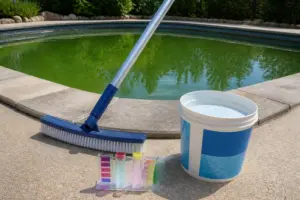
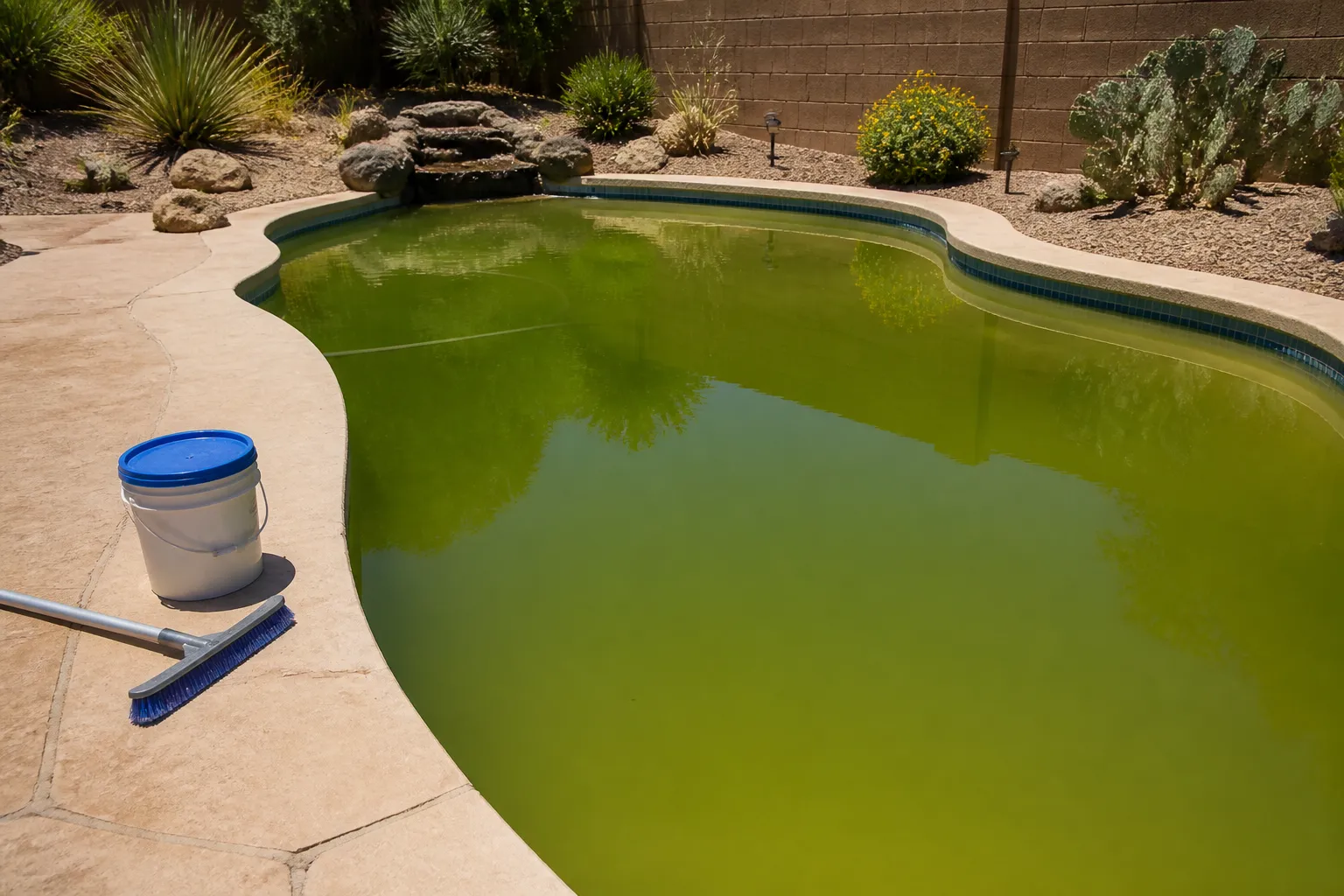
It’s July in Scottsdale. You went to bed last night with a crystal-clear pool, and you woke up to what looks like a swamp. I’ve been there—actually, I’ve managed enough resort and HOA pools across the Southwest to tell you that this scenario plays out almost weekly during monsoon season. The worst part? That panic moment when you realize the pool service lapsed for three weeks during that brutal 115-degree heat wave, and now you’re staring at an opaque green soup wondering if you can fix this yourself before the HOA sends the second notice.
Here’s what I want you to know: a green pool in South Scottsdale isn’t a judgment on you as a pool owner. It’s a perfect storm of desert conditions that move faster than anywhere else in the country. And yes, you can fix it—but you need to understand what you’re fighting and use the right tools. In my fifteen years managing pools from Phoenix to Tucson, I’ve learned that standard green pool advice written for Florida doesn’t apply here. The Southwest requires more aggressive intervention, smarter chemistry, and products specifically designed for desert conditions.
Let me walk you through exactly what I’d do if this was one of my pools.
Why This Problem Is Worse Than You Think
Before you convince yourself that a slightly green pool is just cosmetic, let me explain what’s actually happening in that water—and why the clock is ticking faster in the desert than anywhere else.
In a typical climate, a pool that turns slightly green over 48 hours gives you time to respond. In South Scottsdale, you don’t have that luxury. Here’s why:
The Desert Chemistry Problem
Arizona’s water is notoriously hard. I’ve tested pools in South Scottsdale with calcium hardness levels of 500+ ppm straight from the tap—compared to a healthy range of 200-400 ppm. When you add 115-degree air temperatures, your water temps climb to 90-95°F. Every degree of temperature increase doubles the rate of chlorine breakdown. That means your chlorine residual isn’t just declining—it’s evaporating faster than you can measure it.
Simultaneously, the intense UV radiation in the Arizona sun destroys chlorine molecules at a rate that’s unmatched anywhere in the country. We’re talking about near-sea-level elevation and relentless, cloudless days for months. That chlorine you added yesterday? 60% of it might be gone by sunset.
The Organic Load Factor (Yes, Haboobs Are Real)
I managed a resort pool that went from crystal-clear at 6 PM to noticeably cloudy by morning—not from algae growth, but from a dust storm depositing organic debris overnight. A single haboob (those walls of dust you see rolling across the valley in monsoon season) can deposit months worth of organic material into an open pool. That organic load becomes the food source that feeds algae blooms faster than any tropical climate.
Add high evaporation rates (Arizona pools lose 1-2 inches per week in summer), and you’re concentrating all of that organic material, minerals, and any existing algae spores into an increasingly unstable chemical environment.
The Real Costs of Delay
Here’s what happens if you wait:
- Equipment damage: A heavy algae bloom will load your filter to the point of failure in 24-36 hours. A cartridge filter that costs $150 to replace, or worse, you damage the pump because the filter’s clogged and pressure spikes to dangerous levels.
- Chemical imbalance: As algae consumes chlorine, your pH drifts upward (calcium carbonate precipitation in hard water), making shock treatment less effective and requiring acid additions that cost money and time.
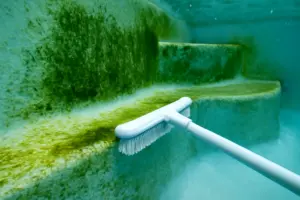
- Black algae: If that green bloom goes untreated for 5-7 days, especially in 90-degree water, some of it can convert to black algae, which is exponentially harder to kill and may require professional intervention.
- HOA fines: In South Scottsdale, community pools that don’t meet health standards can result in fines of $50-200 per day. A two-week untreated green pool? That’s $700-2,800 in potential penalties before you’ve even hired someone to fix it.
- Safety liability: Murky water hides hazards. Drowning statistics are highest in unclear water because lifeguards and swimmers can’t see obstacles or other people underwater.
The point: a green pool Arizona fix isn’t optional—it’s urgent. And doing it right the first time costs a fraction of the alternative.
What to Look For in a Green Pool Treatment Kit
Not all algaecides are created equal, and in the Arizona market, you’ll find products that simply don’t work for our unique chemistry. I’ve tested dozens of brands, and here’s what separates effective treatments from expensive disappointments.
The Algaecide That Actually Stops Desert Blooms Before They Take Over
In Arizona’s heat, algae doesn’t just grow—it explodes. Once your pool turns green, you need something that works fast enough to prevent that three-day recovery spiral, especially when UV intensity and 110-degree water temperatures are working against you.
What works
- Stops active algae growth in hours, not days—critical when your water temperature is climbing and algae multiplies by the hour in desert sun.
- Works alongside chlorine shock treatments without creating chemistry conflicts, so you’re not guessing whether your fix is actually working.
- Prevents re-bloom during monsoon season when humidity spikes and your chlorine gets burned off faster than you can replace it.
What doesn’t
- It’s not a substitute for chlorine—this is a support tool, not a magic bullet, so you still need solid sanitizer levels or the algae comes roaring back.
- In extreme neglect situations (like mine that July), you may need two doses instead of one, which means waiting and dosing again rather than a single fix.
I’ll admit: the first time I dosed this on that green swamp, I waited six hours and saw maybe 20% clearing—I genuinely thought I’d wasted money and would be draining the whole thing. But by hour 18, combined with shock treatment and circulation, the water went from murky to almost clear. Get the HTH 67244 Swimming Pool Care Algae Guard Ultra before monsoon hits, not after.
This post contains affiliate links. As an Amazon Associate, I earn from qualifying purchases at no extra cost to you.