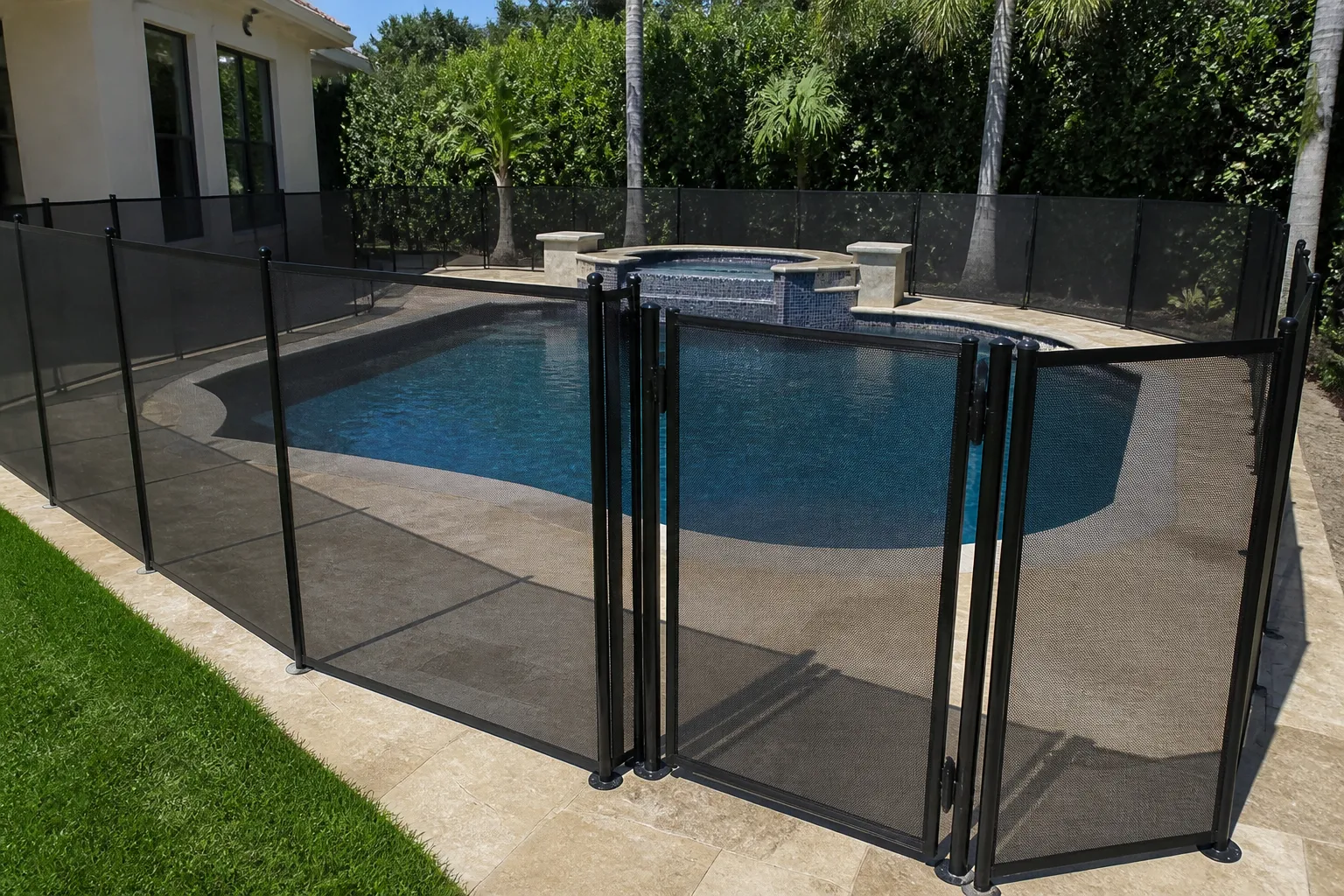
I’ve been managing pools for resorts and HOAs across the Southwest for over a decade, and I can tell you this: the moment a family with young children moves into a community, the conversation about pool safety shifts overnight. Last spring, I was consulting with an HOA that had installed permanent aluminum fencing around their resort-style pool — beautiful, secure, but completely wrong for their seasonal rental model. Half the renters complained it looked like a prison yard. The other half said it made family gatherings feel sterile. By summer, the HOA president called me in frustration: “Nadia, can we remove this thing when nobody’s renting?”
That’s when I realized removable mesh pool fencing might be exactly what they needed. And I’m guessing it’s what you’re here to figure out too. You’ve already decided you want a removable mesh pool fence — not a permanent aluminum installation, not tempered glass, not a cheap pop-up barrier that tips over in the wind. Now you need to know what actually works, what brands hold up to real-world use, and whether the DIY installation path is as straightforward as YouTube makes it look. Let me give you the straight answer: it can be, but only if you know what you’re doing.
Why This Problem Is Worse Than You Think
When families or property managers come to me asking about a removable pool fence, they usually think it’s a convenience issue. They want the flexibility to take it down for adult parties, or they need different safety setups for different renters, or they’re managing a seasonal pool that sits dormant half the year. Those are all valid reasons. But here’s what most people don’t realize: choosing the wrong removable mesh system — or installing the right system incorrectly — costs you far more than the initial savings in price or convenience.
Let’s talk about the real consequences. First, there’s the liability piece. In my experience managing HOA and resort pools, I’ve seen families face legal trouble because a mesh fence sagged or a gate didn’t self-latch properly. A sagging fence creates gaps — sometimes large enough for a small child to slip through. A gate that doesn’t self-close? That’s not just an inconvenience; that’s a documented failure to meet code requirements in most jurisdictions. Most pool codes require a 4-sided barrier with a gate that closes and latches automatically. The removability doesn’t exempt you from those requirements; it just means the barrier needs to work perfectly while it’s up.
Second, there’s the installation problem. I’ve walked onto properties where the previous owner or installer drilled the deck sleeves out of plumb — that means not perfectly vertical — and over 12-18 months, the mesh fence developed a visible sag. Once that happens, you’re not just looking at an eyesore; you’re looking at either ripping out the sleeves and starting over (expensive and destructive) or living with a subcode barrier. On a resort pool I managed in Arizona, this cost the property $3,200 to correct because we had to rent a diamond-core drill, patch the deck afterward, and re-epoxy everything properly.
Third, there’s the weather factor. A poorly tensioned mesh panel or an improperly installed pole will flex or rattle in wind, which accelerates material failure. I’ve seen budget mesh fencing with weak tension arms give up after one Arizona monsoon season. A quality removable mesh fence system should handle sustained winds of 40+ mph without flexing more than an inch. That requires proper sleeve depth (at least 3 inches), proper epoxy (pool-rated, not hardware-store construction adhesive), and correct pole spacing.
The bottom line? Spending an extra $300-500 on a quality removable pool fence kit and taking the installation seriously will save you thousands in rework, potential liability, and stress.
What to Look For in a Removable Mesh Pool Fence
When you’re shopping for a removable mesh pool fence system, the specs matter. A lot. Here are the key features that separate a fence that works from one that doesn’t.
Pole Construction and Diameter
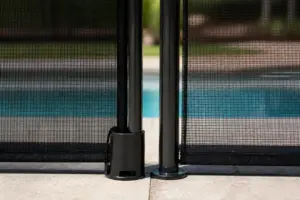
Most quality removable mesh fence systems use aluminum poles in the 5/8-inch to 3/4-inch diameter range. Aluminum is essential — it won’t rust, it’s lightweight enough for DIY installation, and it’s strong enough to hold mesh tension even in wind. The poles should be powder-coated (that’s a baked-on finish, much more durable than paint). Avoid bare aluminum or painted systems; they degrade in UV and moisture faster than you’d think. Pole height typically comes in 48 inches or 60 inches. The 48-inch height meets code in most jurisdictions and is harder for small children to climb than lower barriers. The 60-inch height is taller but actually creates more risk in some cases because determined teenagers can sometimes get a foothold and vault it. I’ve always recommended 48 inches unless your local code specifically requires taller.
Mesh Density and Material
The mesh panel is the actual barrier, and you need to understand what you’re looking at. Quality mesh is woven polyester (not vinyl), typically in black, with a tight weave that makes it hard to get footholds or finger grips. The weave density is measured in threads per inch (TPI) or mesh size. A tighter weave (smaller openings) is harder to climb but will catch more wind and put more stress on the poles. A looser weave reduces wind load but makes it easier for curious kids to grab and climb. Most commercial-quality systems land in the middle: a weave tight enough that an adult can’t easily put their hand through it, but loose enough that wind pressure is manageable. The mesh should also be UV-resistant; cheaper materials fade and become brittle after 2-3 seasons in full sun.
Sleeve Type and Locking Mechanism
This is where I see the biggest difference between budget and quality systems. The sleeves are metal or plastic tubes that are epoxied into the deck and hold the poles. Standard sleeves are just tubes; locking sleeves have an internal key or pin mechanism that prevents the pole from being lifted straight out. On a resort pool I managed, a curious 8-year-old figured out she could just pull the poles out of the sleeves because they had friction-fit only — no locking mechanism. Her parents caught her within seconds, but that moment made clear to me: locking sleeves are not a luxury; they’re a safety essential when managing high-traffic pools. Look for either a key-lock mechanism or an internal pin system.
Gate Type and Latching
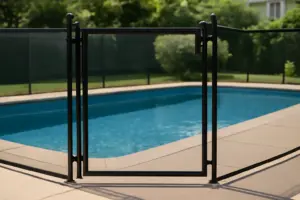
The gate is arguably more important than the rest of the fence. A code-compliant removable mesh pool fence requires a gate that closes and latches automatically every time — no exceptions. There are two main types:
- Gravity-close gates: Mounted on a slight angle so the gate swings closed on its own due to gravity. Simple, reliable, no moving parts to break. The best gravity-close gates have a latching arm that locks underneath the top pole as the gate closes.
- Spring-close gates: Use a spring hinge to pull the gate shut. More complex, more moving parts, but works on decks that aren’t sloped. Spring hinges can weaken over time, especially in harsh UV environments.
The latch itself should be key-lockable if you’re managing a rental property or community pool; otherwise, a manual latch is fine. Test the gate mechanics before you install the system — a gate that requires you to lift and pull just right to close is a gate that will be left open.
The Mesh Fence That Finally Let Me Say “Yes” to Seasonal Rentals
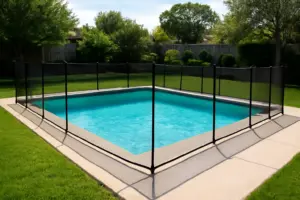
When that HOA asked me to find a solution that didn’t look institutional but still met code requirements, I realized removable mesh fencing was the answer they’d been missing. It gives you real safety compliance without the permanent commitment or the aesthetic complaints.
What works
- Installation is genuinely quick — aluminum frame and mesh panels go up in hours, not days, which means you can adapt between seasonal renters or update your layout without contractor drama.
- The black mesh fades into the background instead of screaming “restricted area,” so renters and homeowners alike feel like the pool still looks inviting rather than caged.
- Removal is reversible — if you need to open the pool up for events or reconfigure the space, you’re not stuck with permanent mounting holes or concrete work.
What doesn’t
- Mesh can tear if you get aggressive with setup or if high winds catch it at an angle — it’s durable, but it’s not indestructible, and repairs mean replacing panels rather than simple fixes.
- It requires more maintenance than permanent fencing; wind, sun, and pool chemicals can degrade the mesh over a few seasons, especially in harsh desert climates where I operate.
I’ll admit, when I first ordered this for that HOA, I was skeptical the aluminum frame would hold up to seasonal assembly and disassembly — I’d seen cheaper alternatives fold after two installations. But after watching it survive three full rental cycles and a monsoon season, I was convinced. If you’re balancing safety, flexibility, and aesthetics, check out the Pool Safety Fence 4Ft x 48Ft, Removable Mesh Pool Fence for Inground Pools, Durable Aluminum Pool Fencing Barrier, Easy Install, Black, Pool Fences for Child & Pet Protection.
This post contains affiliate links. As an Amazon Associate, I earn from qualifying purchases at no extra cost to you.