I’ve been managing pools for fifteen years—resort pools in Arizona, community pools for HOAs, commercial facilities you’d recognize—and if I had to name the single most common complaint I hear from pool owners who test their water regularly, it’s this: “Nadia, my pool pH keeps rising. I add pH down, wait 24 hours, test again, and it’s right back up to 8.0. I feel like I’m pouring money down a hole.”
Here’s the thing: it’s not random. It’s not bad luck. Your pool pH keeps rising because something specific is driving it up—and once you identify what that something is, you can fix the actual problem instead of playing chemical whack-a-mole every week. That’s what this post is about.
I’ve seen pools where owners were spending $40–50 a month on pH reducer because they didn’t understand the root cause. Once they addressed it, that number dropped to $8–10. So let’s dig into why this happens, what it actually costs you, and how to stop it.
Why This Problem Is Worse Than You Think
Most pool owners think high pH is just an annoyance—a number on a test strip that needs to be lower. That’s not quite right. High pH is actively working against you in several ways, and the cost compounds quickly.
First, chlorine effectiveness plummets. This is the big one. Chlorine only kills algae and bacteria in one chemical form: hypochlorous acid (HOCl). At pH 7.2, roughly 66% of your chlorine exists as HOCl—the effective form. At pH 7.8, that drops to about 30%. At pH 8.0, you’re down to roughly 3%. Let me say that again: at pH 8.0, only 3% of your chlorine is actually working. That means if you’re maintaining 2 ppm of chlorine at pH 8.0, you’re only getting the disinfection power of 0.06 ppm. Effectively, your chlorine is 20× less powerful at the same ppm reading. You’re not buying more chemicals because you want to—you’re buying them because they don’t work.
Second, calcium scale deposits form. High pH shifts the water’s saturation chemistry, and calcium precipitates out of solution. This deposits on pool surfaces (leaving white, rough spots that are painful to brush), on equipment (pump seals, filter heads), and especially on salt cell plates in saltwater pools. Those titanium plates cost $400–800 to replace. Once they’re coated with calcium scale, the cell’s chlorine output drops 30–50%. I’ve replaced salt cells that could have lasted 5–7 more years if the owner had kept pH under control.
Third, your eyes and skin get irritated. Anything above pH 7.8 starts to noticeably irritate eyes and skin. Above pH 8.0, it’s uncomfortable. People assume it’s the chlorine—”chlorine makes my eyes red”—when it’s actually the pH. Fix the pH, and the irritation goes away.
Fourth, your stabilizer (CYA) becomes ineffective. Cyanuric acid stabilizes chlorine against UV breakdown. But at high pH, the CYA molecule spends more time in a form that doesn’t interact well with chlorine. Your 100 ppm of CYA becomes almost invisible to chlorine chemistry at pH 8.0+, which is another reason your chlorine seems weak.
In short: high pH drives you to buy more chemicals, shortens equipment life, damages surfaces, and makes swimming uncomfortable. And here’s the frustrating part—if the underlying cause is high alkalinity or aeration, you can add pH reducer all day long and it’ll just pop back up. You’re treating the symptom, not the disease.
Why Your Pool pH Keeps Rising: The Root Causes
Before you can fix this, you need to understand what’s actually pushing your pH up. There are five main culprits.
1. Aeration (The #1 Driver)
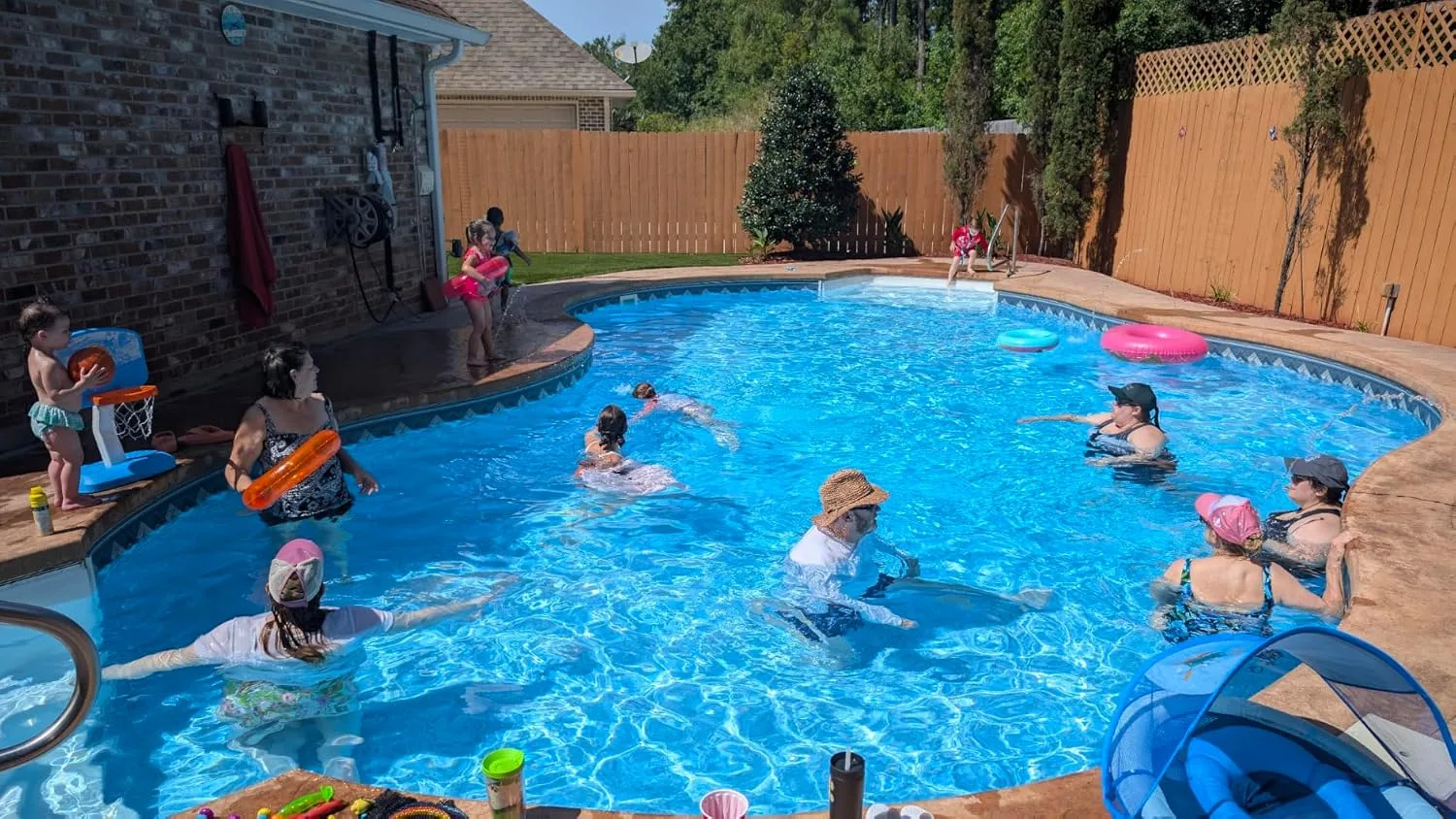
This is responsible for more rising pH problems than any other single factor. Here’s the physics: dissolved CO₂ in water forms carbonic acid, which suppresses pH. Every time water splashes, sprays, or tumbles—return jets angled upward, waterfalls, fountains, kids cannonballing into the deep end, even aggressive pump circulation—CO₂ off-gasses from the water. When that CO₂ leaves, carbonic acid disappears with it, and pH rises.
This is not something you can stop. It’s thermodynamics. But it means that pools with features designed for water movement (waterfalls, spa jets, sheer descents, floor returns) will always fight rising pH harder than a calm lap pool. If your pool has a waterfall and your pH climbs 0.5 pH units per week, you’re not doing anything wrong—that’s normal. You just need to expect it and manage it.
2. High Total Alkalinity (TA)
Total alkalinity is your pool’s pH buffer. It resists change—both downward and upward. The ideal TA range is 80–120 ppm; the sweet spot is 90–100 ppm.
But if your TA is 150 ppm, 180 ppm, or 200 ppm, you’ve created a “pH lock” situation. The water’s buffering capacity is so strong that pH fights your downward corrections and snaps back up within 24–48 hours. You lower it to 7.6, and by tomorrow morning it’s 7.9 again. This is one of the most common scenarios I see, and it’s also the most fixable—but you have to address the TA first.
3. Saltwater Pools (Salt Chlorine Generators)
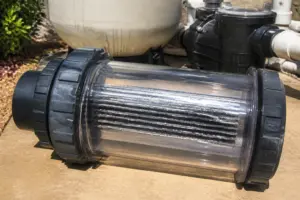
Salt chlorine generators produce chlorine through electrolysis, which has a side effect: it raises pH. The electrolysis process produces chlorine on one side of the cell and alkaline byproducts on the other side. This is why every saltwater pool owner I’ve worked with fights rising pH more aggressively than traditional chlorine pool owners. It’s baked into the technology. Expect to add pH reducer 1–2 times per week in a saltwater pool, even when everything else is dialed in perfectly.
4. Borate-Treated Water
Borate additives (borax or other borate compounds) are used for algae prevention and pH stability. But they shift the equilibrium point of pH. If you’re consistently finding that your pH rises to exactly 7.8 and stops there, borates in your water might be creating an equilibrium. This is less common, but it’s worth considering if you’ve recently added a borate product.
5. Calcium Hypochlorite Shock
Cal hypo shock (the granular, white chlorine shock) is 68% chlorine but has a pH of about 11.8. Shocking with cal hypo dumps a large amount of high-pH material into your pool. On smaller residential pools (15,000 gallons), a single cal hypo shock can raise pH by 0.4–0.6 units. If you’re shocking weekly and your pH is rising weekly, this might be part of it. (Use liquid chlorine or dichlor for routine shocking, and save cal hypo for winter when you don’t need it as often.)
6. Hard Fill Water
In the Southwest and many other regions, municipal tap water is already alkaline—pH 7.8–8.5 straight from the tap. It also has high calcium hardness (200+ ppm in some areas). Every time you top off the pool due to evaporation, you’re adding water that’s already raising the baseline. If you’re in an area with hard, alkaline water, you’re fighting an uphill battle from the moment you fill the pool.
Identifying Your Cause (and Why It Matters)
Before you buy anything, do this diagnostic:
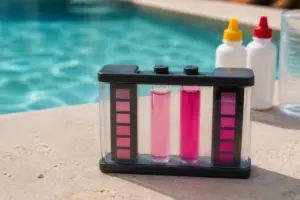
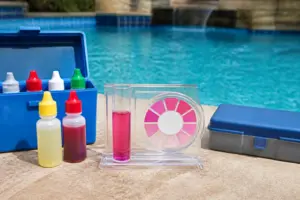
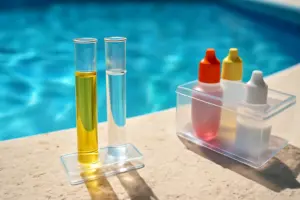
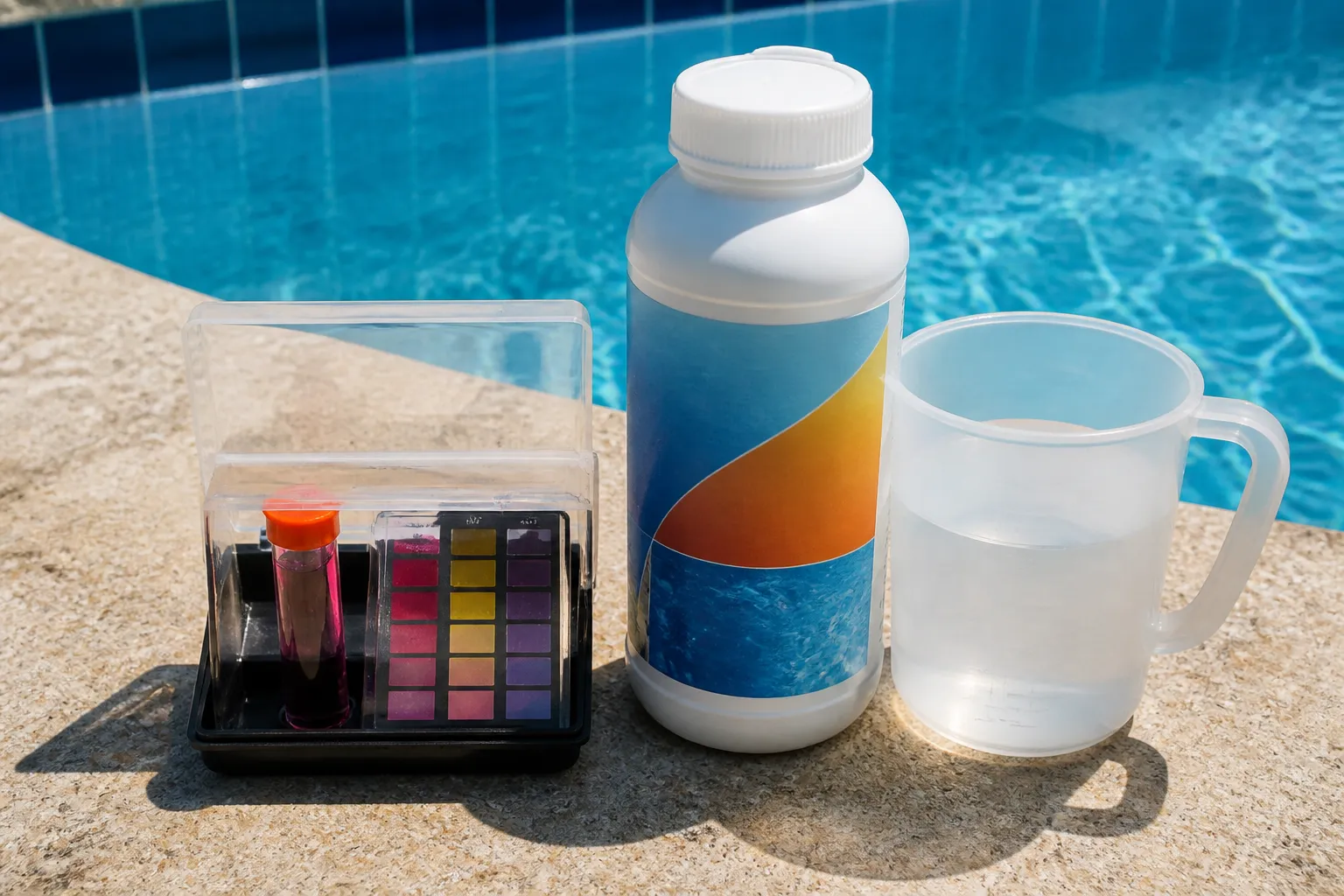
- Test total alkalinity. If TA is above 120 ppm (especially above 150 ppm), that’s your primary problem. TA must come down first, or pH reducer is a temporary band-aid.
- Track your pH over a week. Does it rise faster on days you run the waterfall or let the kids jump in? That’s aeration. Does it rise steadily even with minimal aeration? That’s TA or equipment-related (salt cell, shock chemical).
- Check your shock type. If you’re using calcium hypochlorite, switch to liquid chlorine for a week and see if the pH rise slows.
- Know your fill water. Call your municipal water provider or get the annual water quality report. Many publish it online. If your fill water is pH 8.0 and TA is 120 ppm, you’re starting the game on hard mode.
Once you know what’s driving your rising pH, you can address it systematically instead of reactively.
What to Look for in a Pool pH Reducer
There are two main types of pH reducer used by pool professionals: liquid muriatic acid (hydrochloric acid) and dry acid (sodium bisulfate). Each has strengths and trade-offs.
Muriatic Acid (Liquid)
Pros: Muriatic acid is more powerful per unit volume. A small amount of muriatic acid goes a long way. It’s cheaper per ppm of pH reduction. It lowers TA more efficiently than dry acid. For serious TA reduction jobs, muriatic acid is the tool.
Cons: It’s a liquid, which means it’s corrosive and requires careful handling—goggles, gloves, and ventilation. It can’t be stored as long (it evaporates slowly). You need a safe place to keep it. It requires pre-dilution and careful addition. For residential pools, the handling and storage requirements make it less convenient.
Dry Acid (Sodium Bisulfate)
Pros: It’s a dry granule, so it’s safer to handle and store. No gloves or goggles required (though they don’t hurt). It stores indefinitely without degradation. It’s easy to dose—one scoop, one dose. It’s precise and predictable. For residential pool owners doing routine pH adjustments, dry acid is the everyday choice.
Cons: It’s less powerful than muriatic acid. It doesn’t lower TA as efficiently. For large TA reduction jobs, you’ll need more product. On a cost-per-ppm basis, it’s more expensive.
My recommendation: For most residential pools, use dry acid for routine pH adjustments (weekly or bi-weekly corrections). If you need to reduce TA significantly, use muriatic acid for that job, then switch back to dry acid for maintenance.
The Sodium Bisulfate That Finally Stopped My pH Yo-Yo
If you’re chasing rising pH with weak or inconsistent pH reducers, you’re fighting a losing battle. The right product—one with real alkalinity-lowering power—is the difference between a 48-hour fix and a permanent solution.
What works
- 90% concentration actually lowers pH instead of just masking it—I saw results within 6 hours, not the vague 24-hour guessing game
- 50-pound bulk size means I’m not buying tiny bottles every other week; one container lasts through most of the season
- Works on both the pH rise itself and the underlying alkalinity that keeps triggering the rebound
What doesn’t
- Sodium bisulfate is a powder that needs measuring and dissolving—if you’re hoping for a pour-and-forget liquid, this isn’t it
- A 50-pound bucket takes up real storage space and is heavy to handle if your pool chemistry isn’t already on your routine
I almost gave up on bulk dosing after a few clumsy applications, but once I got my mixing routine down, the consistency made me realize I’d been underdosing with liquids the whole time. If you’re serious about solving pH creep instead of band-aiding it, grab the In The Swim pH Reducer for Swimming Pools, Spas, and Hot Tubs – 90% Sodium Bisulfate – 50 Pounds.
This post contains affiliate links. As an Amazon Associate, I earn from qualifying purchases at no extra cost to you.