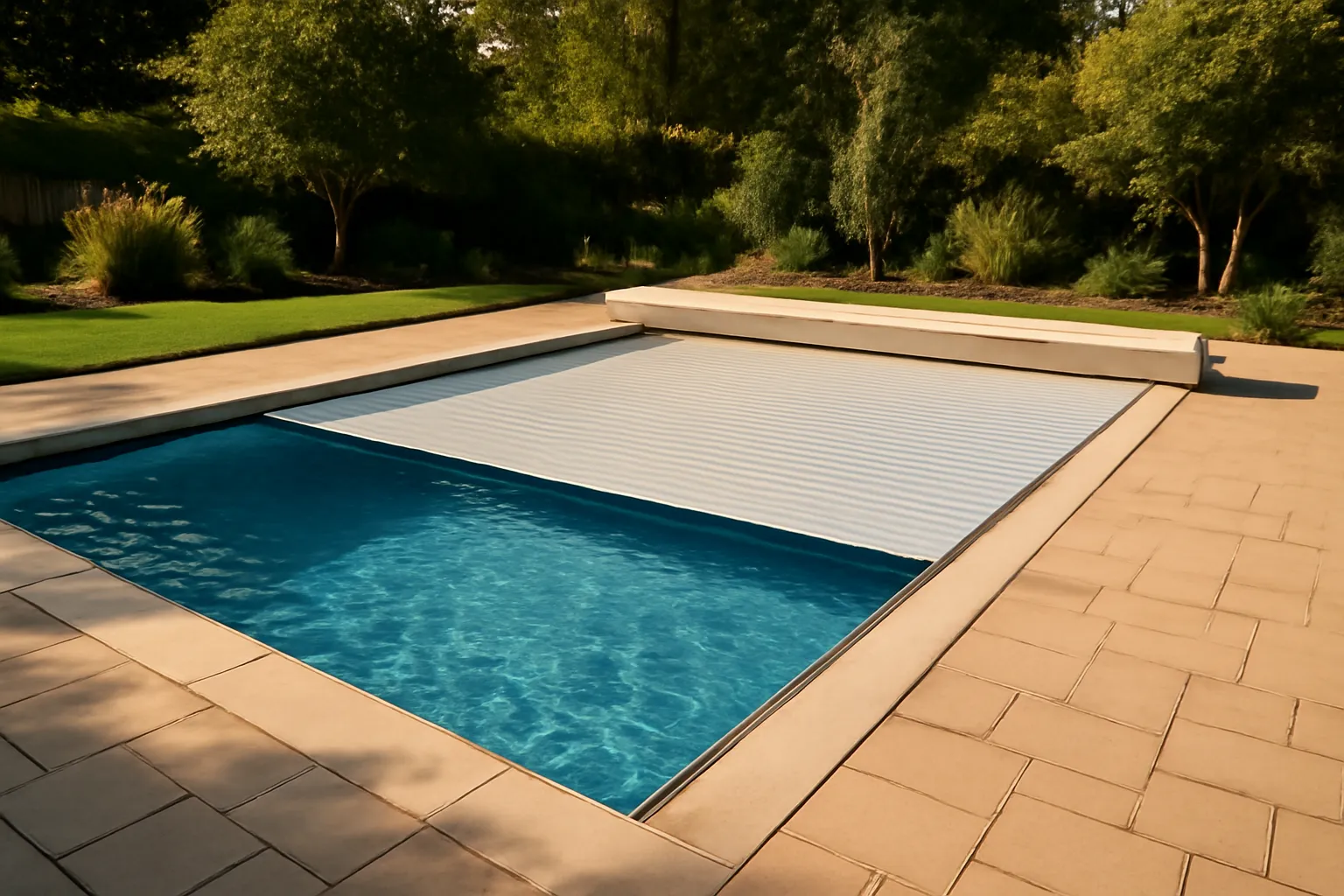
Every season, I get some version of the same question from a new pool owner: “I already have a cover — the blue floating one that came with the house. That’s fine for safety, right?” And every time, I have to take a breath and explain that no, unfortunately, that solar blanket is not a safety cover. Not even close. I’ve managed pools at resorts and HOA communities across the Southwest for years, and I’ve seen well-meaning parents drape a floating solar blanket over their pool and genuinely believe their toddler is protected. They’re not. A floating cover gives way the moment any weight touches it. A child or a small dog can walk right onto it, slip through, and become trapped underneath — unable to surface. That distinction between a decorative or thermal cover and an actual safety cover is the most important thing I can teach a residential pool owner. So let’s talk about the two real options: the automatic pool cover vs manual safety cover. Both can save a life. One costs significantly more. Here’s how to decide which one you actually need.
Why the “Any Cover Will Do” Mindset Is More Dangerous Than You Think
Let me be direct with you: drowning is the leading cause of accidental death in children ages 1–4 in the United States. The CDC has published this data consistently for decades. And a pool that appears “covered” can create a false sense of security that’s arguably more dangerous than no cover at all — because a parent believes the hazard is managed when it isn’t.
A true pool safety cover is defined by the ASTM F1346 standard. This is the certification that matters — the one insurance companies ask about, the one local building codes reference, and the one that actually means something in terms of physical protection. To meet ASTM F1346, a cover must support a minimum of 485 pounds distributed across a specific area without allowing a child or pet to slip underneath. That’s a cover you can stand on. That’s a cover that acts as a physical barrier, not just a visual one.
Floating solar blankets, decorative winter covers, and leaf nets do not meet this standard. Full stop.
Now, beyond the life-safety issue — which is obviously the most critical — there are real financial consequences to using the wrong cover too. At the HOA pools I’ve managed, improper or absent safety covers have led to:
- Massive chemical waste: An uncovered pool can lose 30–50% of its chlorine to UV degradation on a sunny day. At current chlorine costs, that adds up to hundreds of dollars over a swim season.
- Evaporation loss: In the Southwest, an uncovered pool can lose ¼ inch to ½ inch of water per day in peak summer heat. That’s 500–1,000 gallons per week on a typical 15,000-gallon pool.
- Algae blooms during off-season: Sunlight + warm water + no barrier = green water by March. I’ve seen pools that cost their owners $400–600 in shock treatments and algaecide to recover, simply because they used a mesh leaf net instead of a proper cover in winter.
- Debris loading on equipment: Leaves and organic matter decompose in pool water, driving phosphate levels up and choking filters. I’ve seen pump baskets completely packed solid after one windy night with no cover on the pool.
A proper safety cover solves the safety problem and most of these maintenance problems simultaneously. That’s what makes this one of the highest-value upgrades a pool owner can make.
Automatic Pool Cover vs Manual Safety Cover: A Straight-Shooting Comparison
There are two categories of ASTM-certified safety covers, and the difference between them is significant — in convenience, cost, and long-term commitment. This pool safety cover comparison is one I walk through with new pool owners regularly, so let me break it down the way I’d explain it sitting poolside.
Manual Safety Covers
A manual safety cover is a heavy-duty fabric cover — either mesh or solid — that you stretch across the pool and anchor to the deck using spring-loaded rods inserted into brass anchors embedded in the concrete or pavers. When properly installed and tensioned, the cover is taut enough to support the weight of an adult. It is a genuine physical barrier.
Mesh vs. solid: This is the first decision you’ll make within the manual cover category. Mesh covers allow rain and snowmelt to drain through the fabric, which means you never deal with standing water on top of the cover. Solid covers block 100% of light (much better for preventing algae during winterization) but require a submersible cover pump to remove accumulated rainwater — otherwise you’ve got hundreds of pounds of water sitting on the cover, which stresses the anchors and is a hazard of its own.
For most pool owners in the Southwest, I recommend mesh for winter covers because our rain is intermittent and the drainage convenience outweighs the slight algae risk — especially if you close the pool with good chemistry. Solid covers make more sense in wetter climates where algae control over a long winter is the bigger concern.
Cost: $1,200–$3,500 depending on pool size and material quality. Installation of the anchor hardware is a one-time job most homeowners can handle themselves in 2–4 hours with a hammer drill. Putting the cover on and taking it off takes about 10–20 minutes with two people.
Lifespan: A good mesh safety cover lasts 10–15 years. That’s exceptional value.
Automatic Safety Covers
An automatic cover uses a motorized track-and-reel system mounted along the pool edges. Push a button or turn a key, and the vinyl cover rolls out across the pool in about 30 seconds — one person, no effort. For pool shapes that can accommodate the straight parallel tracks required, this is genuinely the most convenient safety solution available.
Cost: $8,000–$20,000 installed, with new construction on the lower end and retrofitting an existing pool on the higher end. The vinyl cover itself needs replacement every 5–7 years at a cost of $2,000–$4,000. Motor and track maintenance runs $200–$500 per year.
Limitations: Track systems can jam with debris. Motors fail. Retrofitting isn’t possible on freeform or irregularly shaped pools. And unlike a manual cover, when something goes wrong mechanically, you’re paying a technician — not pulling out your own drill.
My honest assessment: If the budget is there and your pool shape works, an automatic cover is the single best investment you can make for a residential pool. The convenience factor means you’ll actually use it every single day — not just at the end of the season. That daily use translates into real chemical savings (I’ve seen owners cut their chlorine usage by 30–40%), heat retention (covers can reduce heat loss by up to 70%), and near-zero debris. But for most of the homeowners I talk to, the $10,000–$15,000 price difference between an automatic and manual cover is a real obstacle — and a mesh safety cover does the same safety job at a fraction of the cost.
The Anchor System That Finally Kept My Safety Cover From Shifting Mid-Season
A proper safety cover is only as effective as its anchoring system — and I learned this the hard way when wind and settling ground turned my first cover installation into a sagging liability. Without solid brass anchors that grip concrete and pavers, even the best cover will slip, bunch, and create gaps that defeat the entire purpose of having one.
What works
- Brass construction resists corrosion far better than steel, so anchors don’t rust out and weaken after one or two Southwest monsoon seasons.
- The expanding anchor design grips both concrete and paver surfaces securely, eliminating the guesswork of whether you have the right fastener type for your deck.
- Ten anchors in a pack gives you the coverage you need for most residential pools without buying multiple sets, and replacements are straightforward when one does eventually wear.
What doesn’t
- Installation requires a drill and some patience to set the anchors properly — this isn’t a five-minute job, and rushed installation defeats the whole point.
- They’re anchors only; you still need to pair them with a certified safety cover rated for your pool’s size and weight capacity, so factor that cost in separately.
I’ll admit I almost skipped the anchor upgrade after my first cover installation, thinking the basic straps would hold through off-season. One windy week later, I was re-tensioning the cover and seeing water pooling in the sagging center — that’s when I realized a safety cover with weak anchors is worse than no cover at all, because it creates a false sense of security. Poolzilla Pool Safety Cover Brass Anchors for Concrete and Pavers — 10 Pack solved that problem and gave me one less thing to worry about each season.
This post contains affiliate links. As an Amazon Associate, I earn from qualifying purchases at no extra cost to you.