Every pool owner knows the moment. The pool is finally done — the water is perfect, the patio looks great — and then someone mentions the fence. Maybe it’s your insurance company. Maybe it’s your municipality’s pool code. Maybe it’s your mother-in-law standing in your backyard staring at the pool with that look on her face. Whatever the trigger, you now have to make a decision you weren’t fully prepared for, and a quick search for “pool fence comparison” immediately reminds you that there are about three wildly different options, all with wildly different price tags, and zero consensus on which one is actually worth it. I’ve been a certified pool operator for over a decade, managing everything from resort pools in Arizona to HOA community pools in Nevada. I’ve helped dozens of pool owners work through this exact decision — and I’ve seen the ones who made it wrong realize it years later. Here’s what I actually tell them before they spend a dollar.
Why the Fence Decision Is More Consequential Than Most People Realize
Let’s start with the part nobody likes to talk about: pool drowning is the leading cause of accidental death in children ages one to four in the United States, and the CDC has consistently shown that four-sided pool fencing reduces childhood drowning risk by as much as 83%. That number stops people cold when I say it. I say it anyway, because it’s the reason this decision matters beyond curb appeal and code compliance.
But here’s what makes the choice harder than it should be: local safety codes vary significantly by state and municipality, and they’re not always aligned with best safety practices. Some jurisdictions require only a three-sided fence with the house acting as the fourth barrier. Others require four-sided isolation fencing with a self-closing, self-latching gate. Before you even start comparing fence materials, pull your local pool fence ordinance — your city’s building department website usually has it, or call them directly. Know your minimum height requirement (most codes require at least 48 inches, though 60 inches is safer in practice), your gate latch requirements, and whether your specific fence design needs a permit.
Now the practical complexity: the three main fence types — removable mesh, permanent aluminum, and glass panel — don’t just differ in cost. They differ in installation scope, how they age, how they interact with your pool chemistry environment, and what they look like after two or three summers of UV exposure and splash damage. I’ve seen beautiful glass pool fences turn into cloudy, hard-water-stained embarrassments because the homeowner didn’t factor in cleaning time. I’ve seen aluminum fences rust at the post bases because the installer didn’t properly seal the concrete footings. And I’ve seen mesh fences that were still performing perfectly at year eight because the homeowner knew what to look for when they bought one. The material matters — but so does the spec. Here’s how to think through all three before you commit.
Pool Fence Comparison: Mesh vs. Aluminum vs. Glass, Side by Side
Removable Mesh Pool Fencing
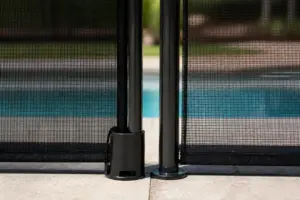
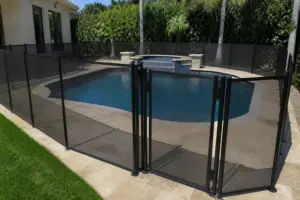
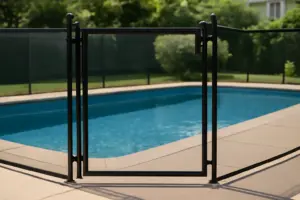
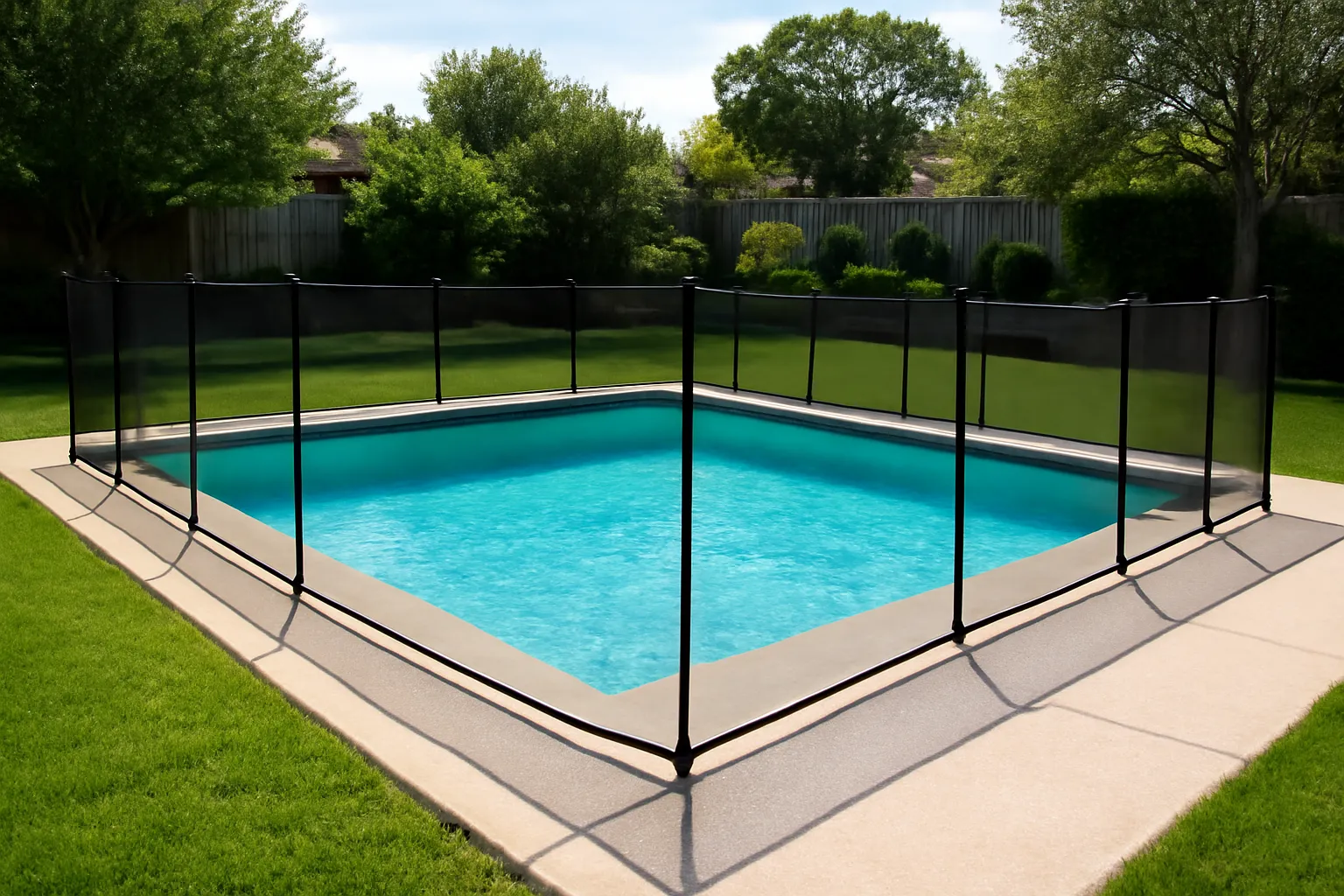
This is far and away the most popular choice for families with young children, and for good reason. The system works like this: aluminum poles insert into deck-mounted sleeves that are drilled into your concrete deck and epoxied in place. Mesh panels stretch between the poles, and tension keeps everything taut and upright. Standard height is four to five feet, and when installed correctly, the mesh is firm enough that a toddler can’t push through it or easily climb it.
Cost runs roughly $15 to $25 per linear foot installed — so for a typical 100-120 linear foot pool perimeter, you’re looking at $1,500 to $3,000 depending on your region and whether you DIY or hire out. Most homeowners can handle the installation themselves in two to four hours with a masonry drill bit, epoxy anchoring adhesive, and basic hand tools. The hardest part is getting the sleeve holes perfectly plumb — if a pole is off-angle, the mesh won’t tension properly.
The big selling point is removability. You pull the poles, roll up the mesh panels, and the only thing left is a ring of small aluminum sleeves flush with your deck — barely noticeable. This is genuinely useful for adult pool parties, family gatherings, or eventually, when your kids are old enough that the fence has served its purpose. Individual sections can be replaced without redoing the whole system, which keeps long-term costs down. Lifespan on quality mesh is five to ten years; the aluminum poles last considerably longer.
Honest drawback: it reads as more “practical” than “premium.” It won’t add measurable property value the way a permanent fence does. And mesh does sag over time if it’s a lower-spec product or if it’s been stored improperly off-season.
Permanent Aluminum Fencing
Powder-coated aluminum picket fencing is the classic permanent option — the kind you see around community pools and upscale residential builds. Posts anchor into concrete footings, and the fence is genuinely there to stay. Cost runs $20 to $40 per linear foot installed, typically $2,500 to $5,000 or more for a full perimeter. Professional installation is recommended because the footings need to be done right, especially in freeze-thaw climates where ground movement can shift posts over time.
Done well, aluminum fencing lasts 20-plus years with essentially zero maintenance — no painting, no rust, just occasional rinsing. It legitimately adds to property value. The tradeoff is permanence: you can’t remove it for a party, and while you can see through the pickets, the sightlines are more interrupted than mesh or glass, especially with decorative styles that have wider rail profiles. It’s also a bigger construction project — budget for the permitting timeline.
Glass Panel Fencing
Frameless tempered glass with stainless steel spigot hardware is the premium, modern choice — and the price reflects it. Expect $50 to $100 per linear foot installed, which means a typical pool perimeter runs $6,000 to $15,000 or more. Installation is professional-only; the panels are heavy, they must be perfectly level, and the hardware torque specs are specific.
The upside is genuinely spectacular: unobstructed sightlines, wind protection for the pool deck, a luxury aesthetic that photographs beautifully. The downside is maintenance — hard water deposits, pool splash, sunscreen smears, and fingerprints show on glass constantly. In my experience managing resort pools in the Southwest, where water hardness regularly runs 300-500 ppm calcium hardness, glass fences need cleaning at least weekly to look good. A panel that gets impacted (a stray patio chair, a hard throw by a kid) will shatter safely as tempered glass is designed to, but replacement panels run $200 to $500 each. And stainless steel hardware near saltwater pools can corrode faster than manufacturers’ warranties anticipate.
The Removable Mesh Fence That Finally Let Me Skip the Permanent Installation Regret
If you’re like me, the thought of permanently bolting a rigid fence to your deck or digging post holes felt like committing to a decision you might second-guess in two years. A removable mesh fence lets you meet code requirements without surrendering flexibility — or your sightlines.
What works
- Sets up in an afternoon without tools or permanent damage to your patio — I had it installed before my insurance inspector even called back.
- The mesh is transparent enough that you can still supervise the pool clearly from inside the house, which defeats the whole “now I can’t see what’s happening” anxiety.
- You can remove it completely during off-season or if you’re selling, which means you’re not locked into one aesthetic forever.
What doesn’t
- The mesh requires hand-tightening and occasional adjustment — it won’t stay taut if you ignore it for a season, and a sagging fence looks worse than no fence.
- Some municipalities don’t recognize removable mesh as meeting permanent barrier codes, so you’ll need to confirm local requirements before ordering.
I almost talked myself out of the removable option because I worried it would look cheap or feel flimsy — but when I actually opened the box and felt the material, the aluminum frame was solid enough to give me real confidence. If you’re in the same headspace, grab the Pool Safety Fence 4Ft x 48Ft Removable Mesh Pool Fence and check your local code first.
This post contains affiliate links. As an Amazon Associate, I earn from qualifying purchases at no extra cost to you.