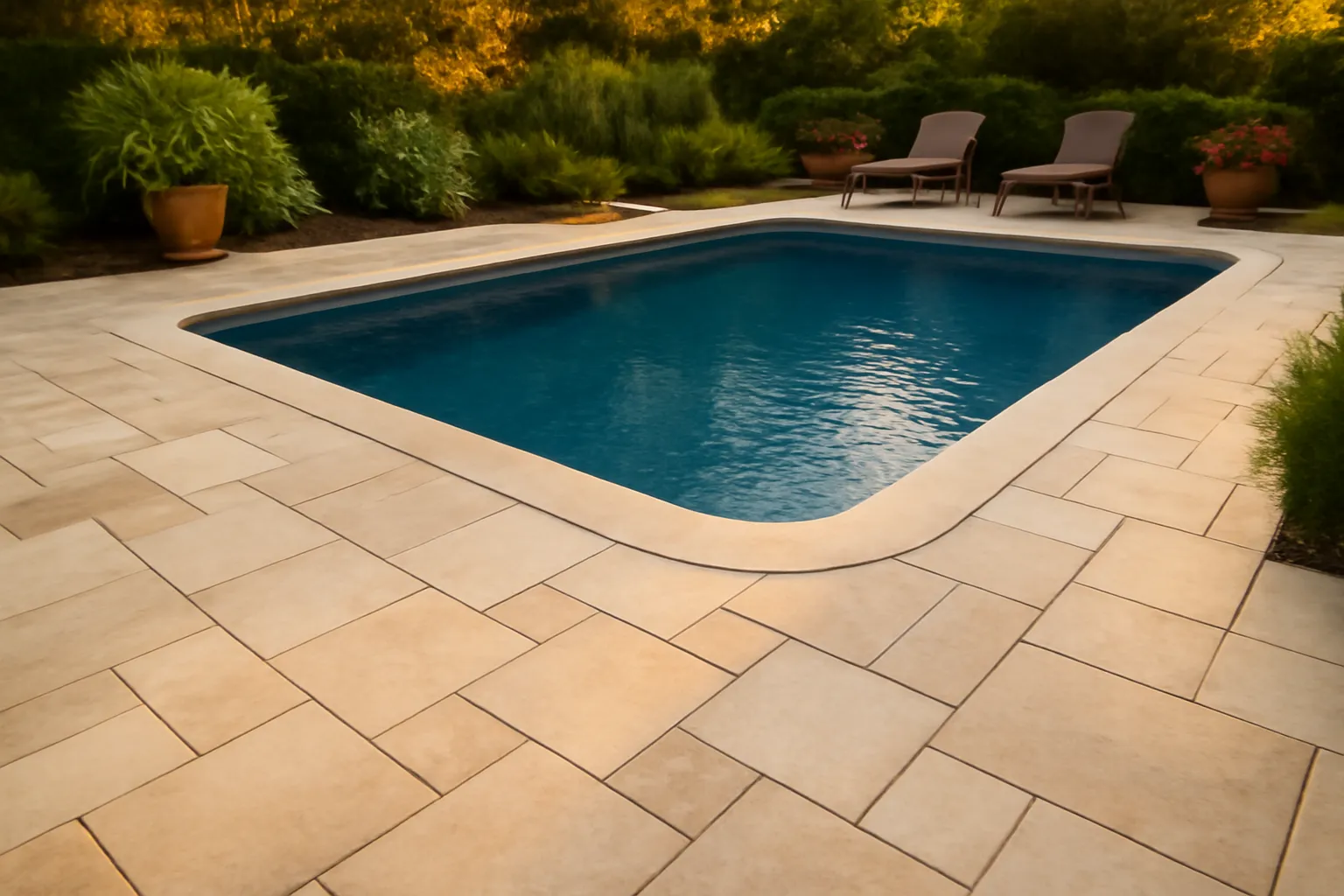
I’ve stood at the edge of more pool decks than I can count — resort pools in Scottsdale, HOA community pools in Las Vegas, private backyard pools in Tucson — and I can tell you with absolute certainty that nothing ages a beautiful pool faster than a cracked, gray concrete slab. Homeowners spend tens of thousands of dollars on the pool itself, then surround it with a poured slab that starts showing its age in three to five years flat. The cracks start small. Then the staining sets in from sunscreen, algaecides, and splash-out. Then someone trips on a lifted edge and suddenly you’re looking at a liability issue, not just an eyesore. If you’ve been scrolling through pool paver ideas at midnight wondering whether travertine is worth the splurge or if concrete pavers will turn your feet into toast in August, you’re in the right place. I’m going to walk you through every material option, what actually matters when choosing, and a product that makes small-area paver upgrades genuinely doable without calling in a contractor.
Why Your Pool Deck Problem Is Worse Than You Think
Here’s what most pool owners don’t realize: that cracked concrete slab isn’t just ugly — it’s actively working against your pool maintenance routine and your family’s safety. Let me break down what I’ve seen go wrong at the pools I manage, because these issues compound fast.
First, drainage. A properly designed pool deck should slope away from the pool at a minimum grade of 1/8 inch per foot — ideally 1/4 inch per foot. When concrete slabs settle and crack, that slope changes. Water starts pooling toward the pool edge instead of away from it. That runoff carries sunscreen, lawn fertilizer, body oils, and environmental debris directly into your pool water. I’ve seen pools with beautifully maintained chemistry — free chlorine holding at 2-4 ppm, pH locked at 7.4 — swing wildly within 48 hours of a backyard party, purely because the deck runoff was funneling contamination back in. You end up dumping extra chlorine and shock, which costs money and throws off your cyanuric acid levels over time.
Second, safety. The CDC estimates that there are approximately 6,700 pool or spa-related injuries treated in U.S. emergency departments every year involving slips and falls, many of which happen on the deck surface — not in the water. A degraded concrete slab develops scaling and pitting that creates uneven surfaces and irregular traction. Ironically, old concrete is both slippery when wet and rough enough to scrape skin badly when someone falls. That’s a terrible combination when you have kids running despite your best efforts to stop them.
Third — and this one surprises people — a cracked deck can affect your pool’s structural integrity over time. Water seeping under a compromised slab near the pool shell can erode the compacted base material and, in worst-case scenarios near older pools, contribute to soil movement around the bond beam. I’ve seen this exact situation at two HOA pools in Arizona. The deck repair bill in both cases ran well past $15,000 once the subbase had to be addressed. A proactive upgrade to pavers, which allow water to permeate through the joints rather than channeling it under a solid slab, eliminates that subsurface saturation problem entirely.
The cost of doing nothing is almost always higher than the cost of doing something right.
Pool Paver Ideas: Breaking Down Every Material Option
Before we talk about the best pavers around pool deck installations, you need to understand what each material actually does — not just how it looks in a Pinterest photo taken at golden hour in perfect lighting.
Travertine — The Gold Standard
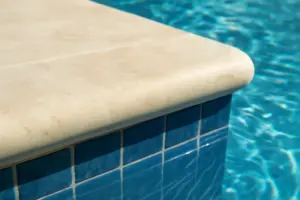
Travertine is genuinely the best performing natural stone for pool decks in hot climates, and I say that as someone who has managed pools where the ambient temperature sits above 105°F for three months straight. Travertine has a naturally porous, tumbled surface that stays dramatically cooler underfoot than concrete — we’re talking 20-30°F cooler on the surface temperature in direct afternoon sun. It’s non-slip when wet due to that tumbled texture, and the muted cream, tan, and walnut tones reflect rather than absorb heat. Installed cost runs $15-30 per square foot depending on your region and the tile grade. The downsides are real though: travertine is porous and must be sealed every 2-3 years, and pool water with a pH below 7.2 will etch unsealed travertine surfaces. If you’re sloppy with your water chemistry, travertine will show it. Color options are also limited — you’re working in a fairly narrow palette of earth tones, which some people love and others find boring.
Concrete Pavers — The Versatile Workhorse
Concrete pavers come in hundreds of colors, shapes, and laying patterns, and they cost $8-15 per square foot installed. They’re the most popular choice for good reason — they’re durable, widely available, and you can achieve almost any aesthetic from rustic to modern. The honest caveat: darker colored concrete pavers absorb significant heat. In Southwest climates, a charcoal or dark gray concrete paver can surface-temp well above 140°F in July. Stick to light gray, buff, or cream tones if heat is a concern. Also, cheaper concrete pavers from discount suppliers can fade noticeably within 3-5 years when exposed to UV and pool chemicals. Spend a little more for pavers with integral pigment rather than surface-applied color.
Porcelain Pavers — The Newcomer Worth Watching
Porcelain pavers are fired at extremely high temperatures, resulting in near-zero water absorption (typically less than 0.5%). They won’t stain, fade, or absorb pool chemicals. Installed cost runs $12-25 per square foot. The critical warning: standard porcelain is extremely slippery when wet. Only use porcelain pavers with a coefficient of friction (COF) rating of 0.60 or higher, and specifically look for textured or grip-finish versions rated for wet outdoor use. Porcelain is also harder to cut for curved pool coping edges, so labor costs can creep up on non-rectangular pools.
Brick — Classic but Temperamental
Brick is affordable at $6-12 per square foot installed, and it has a timeless look that holds its character. But brick absorbs water and pool chemicals readily, which means chlorine splash-out and acid wash runoff will degrade the surface over time. In shaded areas, brick grows moss and algae faster than any other material, and that creates serious slip hazards. The red-orange color also fades to a washed-out pink over 5-7 years in intense UV climates. I’d use brick for a covered patio or garden path — not as my first choice immediately surrounding a pool.
The Paver Upgrade That Finally Stopped Me From Pressure-Washing Every Summer
After years of watching my concrete deck turn gray and spotty by midsummer, I realized I was fighting a losing battle. Slate stone pavers solved what no amount of cleaning could fix — and they’ve actually held up better than the original slab ever did.
What works
- The interlocking design means water drains faster, so algae and staining don’t have time to settle in like they do on solid concrete.
- Individual tiles can be replaced if one cracks — no need to tear up the entire deck like you would with a poured slab.
- The slate texture actually looks better as it ages; the natural weathering gives it character instead of making it look neglected.
What doesn’t
- Installation is more labor-intensive than pouring concrete, so upfront costs are higher — though the durability makes up for it over time.
- You’ll need to occasionally reset pavers if the base shifts, especially in freeze-thaw climates where ground movement is more aggressive.
I was genuinely skeptical that pavers would justify the extra expense, but three years in, I haven’t had to replace a single tile or spend a weekend scrubbing mineral deposits. If you’re looking to stop the aging cycle that plagues concrete, 3rd Street Inn Slate Stone Tiles — Stone Outdoor Interlocking Patio/Deck Flooring Tiles is worth considering.
This post contains affiliate links. As an Amazon Associate, I earn from qualifying purchases at no extra cost to you.