Let me paint you a picture. You’ve just unboxed a pool vacuum kit, and now there’s a vacuum head, a coiled hose, and a telescoping pole sitting on your deck like a disassembled robot. You watched one YouTube video where a guy connected everything in about 11 seconds and made it look like breathing. You’ve watched it three more times. You’re still staring at the pile. I’ve been managing pools at resorts and HOA communities across the Southwest for years, and I promise you — every single pool owner has stood exactly where you’re standing right now. The good news? Learning how to vacuum a pool manually step by step is genuinely straightforward once someone walks you through the parts that actually trip people up. Not the hose-goes-on-the-vacuum-head part. The priming part. The multiport valve part. The “why is there zero suction happening right now” part. That’s what this manual pool vacuuming guide is for. Let’s go from confused to confident.
Why Skipping Proper Vacuuming Is Worse Than You Think
I’ve inherited some genuinely horrifying pool situations during my career — pools that hadn’t been properly vacuumed in weeks, usually because the owner figured the circulation system was handling it. It wasn’t. Here’s what actually happens when debris sits on the bottom of your pool undisturbed.
Organic material — leaves, algae spores, dead insects, sunscreen residue — creates what we call chlorine demand. Your sanitizer gets consumed breaking down that organic load instead of protecting swimmers. I’ve seen pools where free chlorine dropped from a healthy 3.0 ppm to nearly zero within 24 hours simply because of debris accumulation on the floor. You add more chlorine, it disappears, you add more. That’s not a chemistry problem. That’s a vacuuming problem costing you $30 to $60 per month in unnecessary chemical waste.
Then there’s the equipment damage angle. When debris decomposes on a plaster or concrete pool surface, it can stain — and those stains are expensive to remove professionally, sometimes running $200 to $500 depending on severity. On vinyl liner pools, organic acids from decomposing leaves can actually degrade the liner material over time, shortening what should be a 10-to-15-year liner lifespan.
Algae is the worst-case scenario. A light coating of algae on pool walls and floor can go from “mildly green” to “fully swamp” in 48 to 72 hours in warm weather — and at 85°F or above, which is exactly the range pools in Arizona, Nevada, and Southern California run all summer, that timeline shortens considerably. Once you’ve got a green pool, you’re looking at 3 to 5 days of shock treatments, pH adjustments, and filter backwashing before it’s swimmable again. Compare that to 30 minutes of vacuuming twice a week. The math isn’t complicated.
Proper manual vacuuming — the right equipment, the right technique, the right valve setting — prevents all of this. It’s the unglamorous foundation that every other part of pool maintenance sits on.
What to Look For in a Pool Vacuum Head and Hose Set
Not all vacuum heads are created equal, and this is where a lot of pool owners make a purchase they regret. Let me walk you through what actually matters.
Vacuum Head Design and Weight
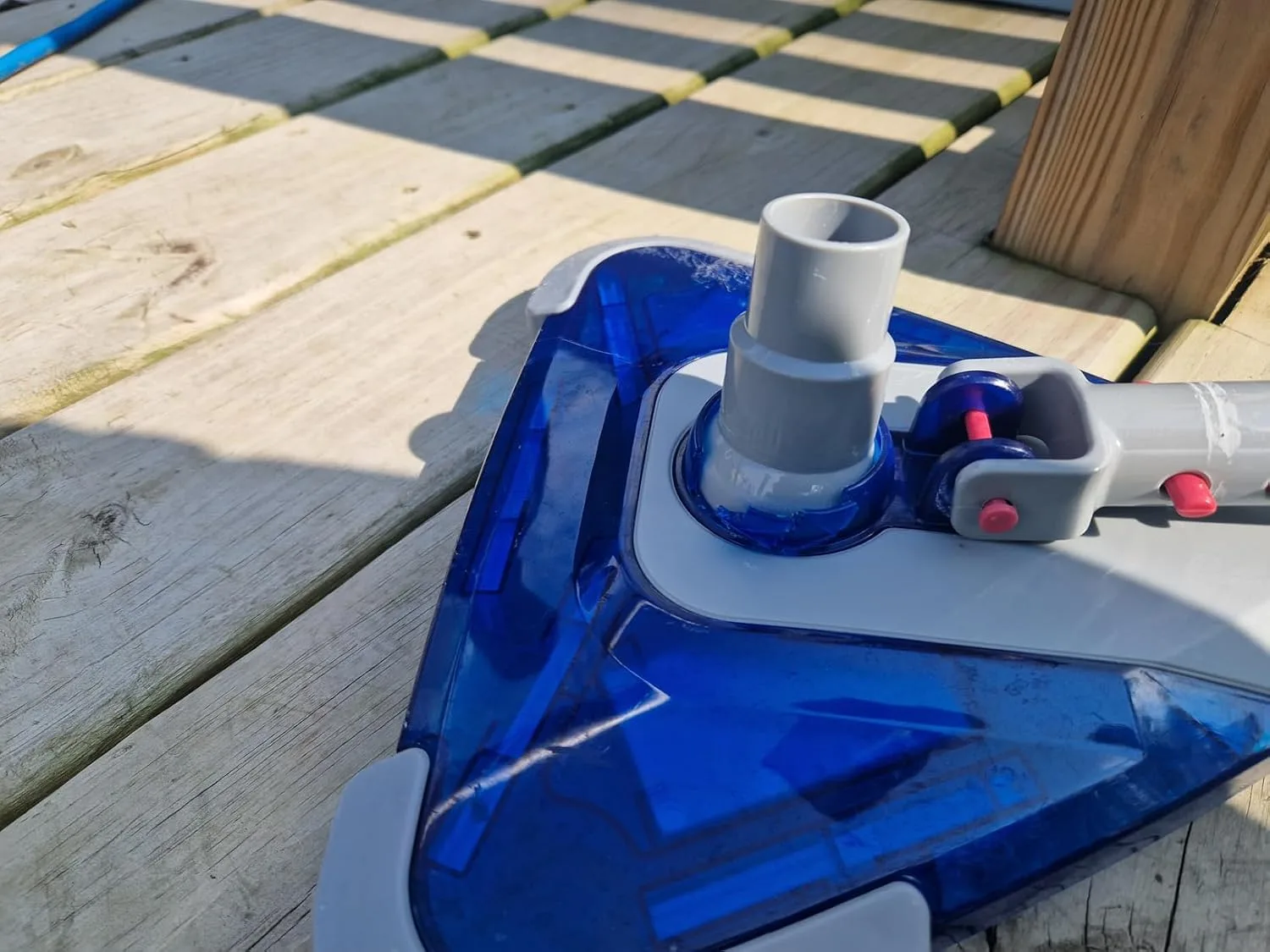
There are three main types of vacuum heads. Lightweight flat heads are inexpensive but float up off the pool floor constantly, breaking suction and making the whole process infuriating. Flexible brush heads work well for vinyl and fiberglass surfaces because they conform to curves without scratching. Weighted vacuum heads are what I reach for when managing concrete and plaster pools — the weight keeps the head planted on the floor so suction stays consistent throughout the stroke. Wheeled vacuum heads add another dimension of ease: the wheels glide the head across the bottom without drag, so you’re not fighting resistance on every pass.
Hose Length and Diameter
This is the spec most people overlook until they’re standing poolside with a hose that’s two feet too short. The rule I use: your hose needs to be at least as long as the diagonal measurement of your pool plus the depth. For a 16×32 foot pool that’s 5 feet deep, that’s roughly 40 feet of hose minimum. Most residential pool owners need 30 to 36 feet. Diameter matters too — 1-1/2 inch is the standard for residential systems and delivers the suction pressure most pumps are designed to work with.
The Vacuum Head That Finally Stayed Put Instead of Spinning Like a Broken Compass
One of the biggest reasons people skip vacuuming isn’t laziness—it’s frustration. A vacuum head that twists, catches the hose, or drifts sideways turns a 20-minute job into a 45-minute wrestling match. That’s when most pool owners just… stop doing it.
What works
- The weighted rotatable handle keeps the head stable and facing forward—no more chasing it across the pool floor as it spins toward the drain.
- The 36-foot hose is long enough that you’re not constantly reconnecting sections mid-vacuum, which means you actually finish the job without getting frustrated and giving up halfway.
- The wheels glide smoothly over the floor without dragging or getting stuck on the pool wall, which makes a real difference when you’re vacuuming around stairs or shallow ends.
What doesn’t
- The 1-1/2-inch hose diameter is industry-standard but not the thickest—if your pump has higher suction power, you might experience slight performance loss on larger debris.
- At this quality level, you’re paying for durability and design; it’s not the budget option, so expect a higher price point than basic vacuum kits.
I’ll admit: the first time I assembled mine, I was skeptical that weighted handle would actually make a difference—after years of cheap kits twisting on me, I was half-expecting the same old dance. But within the first pass across my deep end, I felt it. This is the equipment that finally made me want to vacuum on schedule. Check out the POOLWHALE Professional 1-1/2-Inch x 36-Feet Swimming Pool Vacuum Hoses and Weighted Rotatable Handle Vacuum Head with Wheels if you’re tired of fighting your vacuum.
This post contains affiliate links. As an Amazon Associate, I earn from qualifying purchases at no extra cost to you.